While the power is out
Wine is far more forgiving than milk. A cabinet of bottles holds its temperature for a long time because the glass and the liquid carry a great deal of stored cold, and the insulated walls slow the gain further. Marvel's advice for a power failure is short: correct it as soon as possible and open the door as little as you can.
Ready.gov advises turning off or disconnecting appliances during an outage, because power can return with surges or spikes. For a cooler with an electronic control, switching it off at its power key or unplugging it until the supply has been steady for a few minutes is a sensible habit. If the outage runs through a hot day and the house climbs past 80°F, move the bottles that matter most to the coolest, darkest spot you have.
- Keep the door shut; there is nothing to gain from checking the bottles every hour.
- Unplug or switch off the unit so a returning surge cannot reach its control.
- Never run a generator indoors; Ready.gov wants it outside, at least 20 feet from windows, doors and attached garages.
- Note roughly when the power went out and when it returned.
Source: Marvel — Owner's guide and service manual, undercounter wine models (MLWC324) — In a power failure, correct it as soon as possible and minimize door openings while the power is off; Ready.gov — Power outages — Turn off or disconnect appliances because power may return with surges or spikes; use generators outdoors, at least 20 feet from windows, doors and attached garages
When the power comes back
Plug the cabinet in, or switch it on, once the house supply has held for a few minutes. Then work through three questions in order, and write down anything unusual before pressing more keys.
Did it start at all?
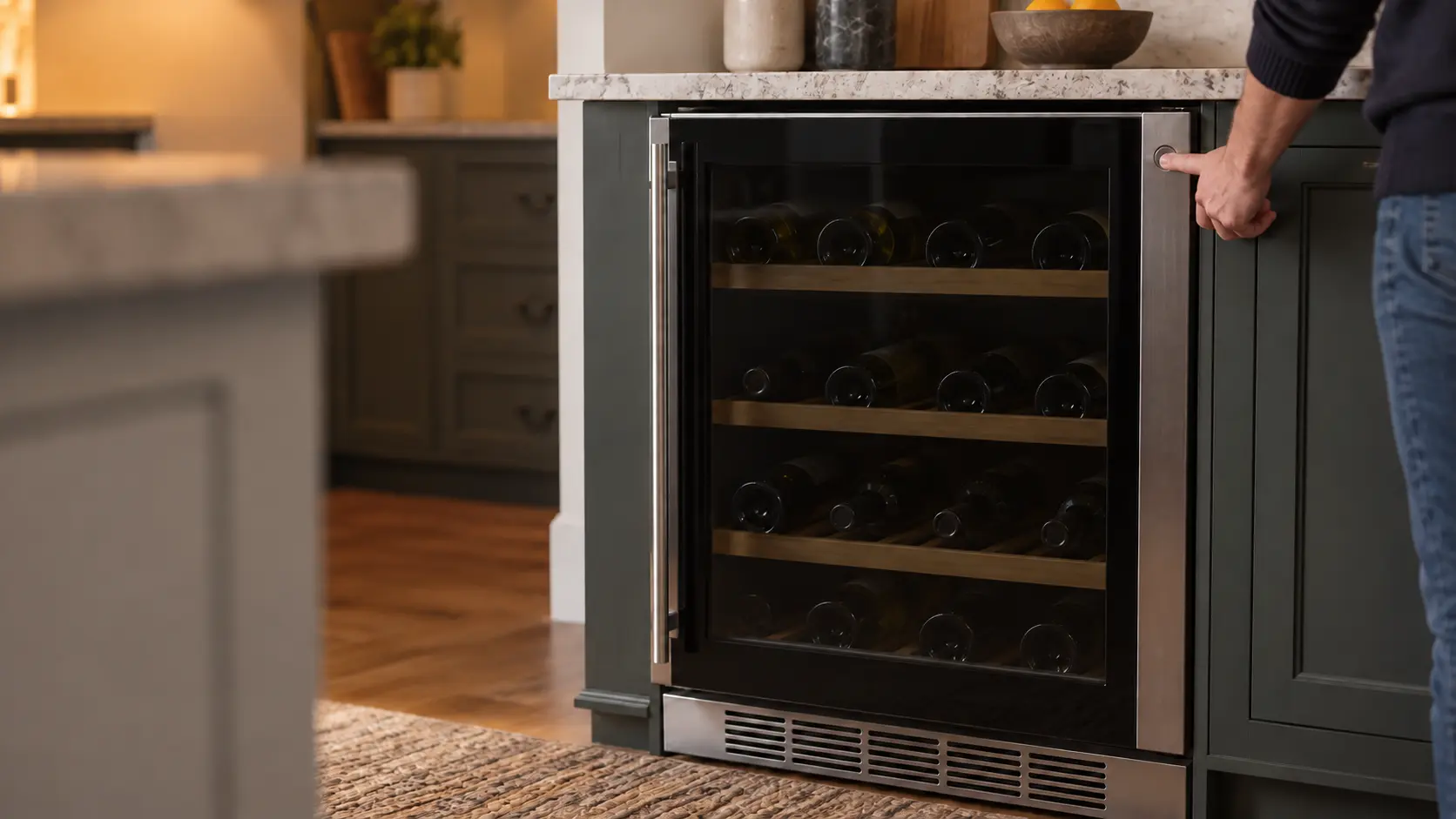
The display should light and, within a short while, a fan or the compressor should run. Some controls stay off after power loss until the power key is pressed; U-Line's controls switch on and off with a hold of about five seconds on that key. A dark cabinet on a working outlet needs the breaker and any outlet reset button checked, since a surge can trip either one.
Did it keep its settings?
Not every control remembers. GE's wine chillers fall back to their Red Wine setting of 55°F after power is lost, which suits storage but not a zone kept colder for whites. Check each zone's set point, the °F or °C choice, the lighting mode and any keypad lock. If the display shows a code, copy it before clearing it.
Alarms once it restarts
A cabinet that warmed while it was off may sound a temperature alarm once it starts again, and that is expected. Silence it the way the manual describes and give the cabinet time; an alarm that keeps coming back after a full day is the one worth noting for a technician.

The first 24 to 48 hours
Leave the setting where it belongs and let the cabinet work. U-Line asks for 24 hours for the temperature to settle after any change, and GE allows up to 48 hours for a fully loaded cabinet to reach its setting. Turning the setting colder to hurry things along only risks an overshoot once the bottles catch up.
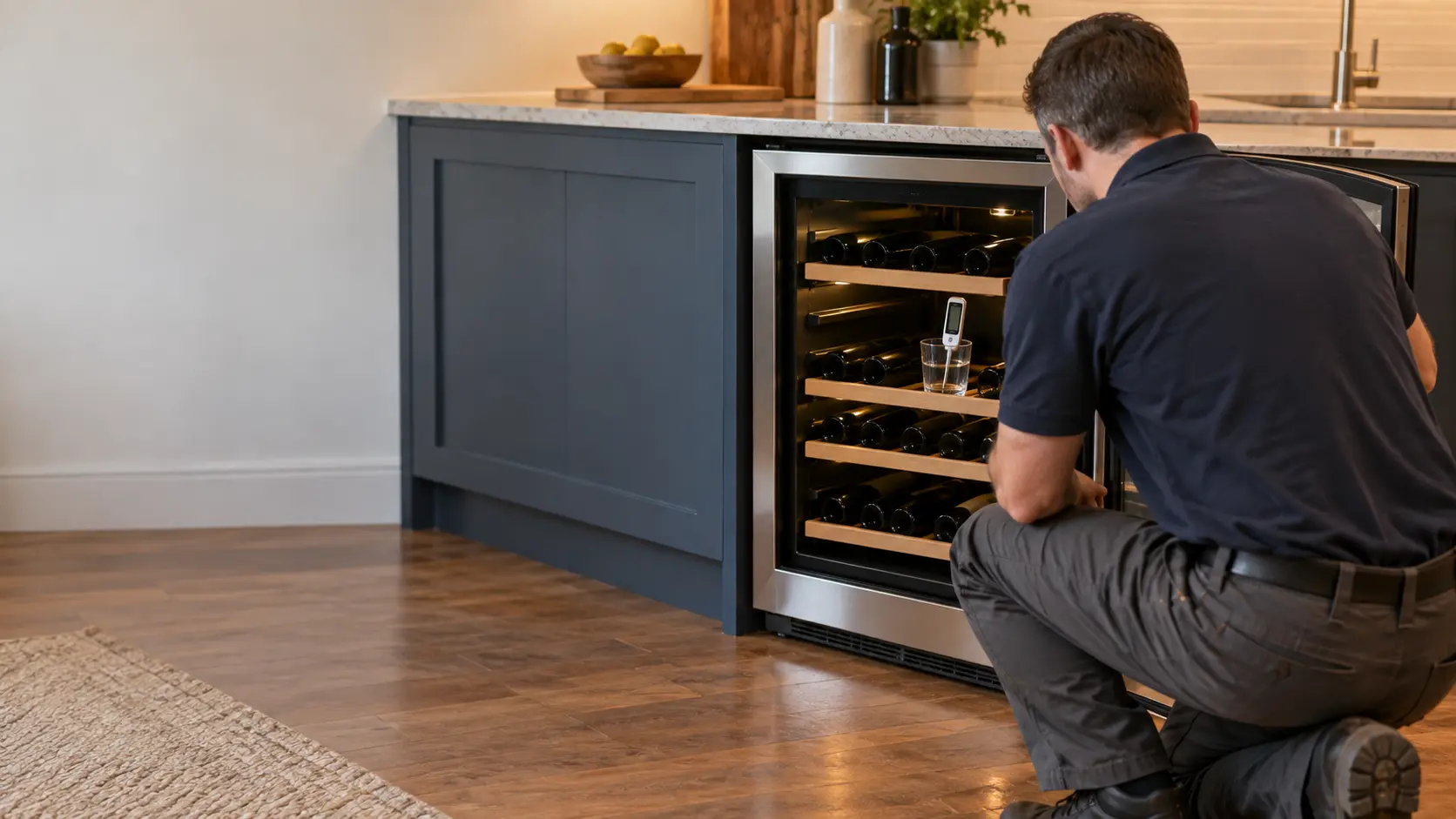
Follow the recovery with a capped bottle of water and a thermometer on a middle rack. A steady fall over the first day is what you want; a cabinet that has not moved after 12 hours, or that runs but stays near room temperature, did not restart properly.
- After a few hours: the air reading should be falling.
- After 24 hours: the water close to the setting on most units.
- After 48 hours: a full cabinet settled, and any remaining gap worth reporting.
Source: U-Line — Dual Zone Wine Captain models use and care guide — The unit turns on and off by holding the power key about five seconds; allow 24 hours for the temperature to stabilize after a change; wine stable between 40°F and 65°F remains sound and larger fluctuations can affect the cork's seal; GE Appliances — Wine Chiller: wine is too warm or too cold — After power is lost the wine chiller defaults to the Red Wine 55°F factory setting; a fully loaded empty chiller may need 48 hours to reach temperature
When the outage damaged the cooler
Most wine coolers come back unharmed, but a few signs after a storm point to damage rather than a slow recovery. A control with garbled segments or one that restarts itself, a compressor that clicks and stops again and again, a breaker that trips as the unit starts, or a burning smell all belong to a technician. Keeping the unit switched off until the supply is steady avoids restarting it into flickering power in the first place.
Thermoelectric units
A thermoelectric cabinet has no compressor to strain, but its control and fans are electronic. If it returns with a working display and a silent inside fan, or a cabinet that warms instead of cooling, the module or a fan did not survive. Newair says most such units will not go below about 50°F, so judge the recovery against that rather than against a compressor unit's range.
What the outage means for the wine
A short, steady rise matters far less than repeated swings. U-Line's guide notes that wine kept stable anywhere between 40°F and 65°F stays sound, and that larger fluctuations can loosen a cork's seal. A bottle that pushed its cork up or seeped around the capsule during a hot outage should move to the front of the rack, to be opened soon rather than kept for years.
Source: U-Line — Dual Zone Wine Captain models use and care guide — The unit turns on and off by holding the power key about five seconds; allow 24 hours for the temperature to stabilize after a change; wine stable between 40°F and 65°F remains sound and larger fluctuations can affect the cork's seal