


wine cooler repair specialists
Kept cellar cool.
Every bottle
in good hands.
Repairs for the cabinet that keeps the collection resting.
Describe what went wrong. We’ll track down the cause.
- Compressors and thermoelectric modules
- Sensors, fans and dual-zone dampers
- Undercounter, column, freestanding
What to expect
Experienced technicians
More than 12 years in appliance repair
Upfront pricing
The cost of the repair in writing, before any work begins
OEM parts on order
Original manufacturer parts ordered against your model number, never third-party substitutes
Warranty on our workmanship
Every repair is backed by a warranty on the work we performed
Your next step
to a working wine cooler.
A few details now.
A little less to worry about.
Describe the wine cooler's trouble
Mark the wine cooler and describe what the bottles, the zones or the display are doing.
Pick a day
Select a date and whichever arrival window suits you.
Say where it stands
Type the address and a number where the technician can reach you on the way over.
Every wine cooler carries a small label with its brand and model: an undercounter wine cooler usually carries it on a side wall inside the cabinet or behind the bottom rack, a wine column along the inside edge of the door opening, and a freestanding unit on the inside wall or on the back near the power cord. With them we know the exact cabinet before we arrive.
or call (844) 709-0727
Loading appointment form…
The appointment form couldn’t load. Please try again.
Four steps,
and no surprises.
The three steps in the form are how you book. These four are what actually happens once a technician is standing in your home.
Each zone measured first
The technician measures each zone and the air leaving the grille, listens to the compressor or the cooling module and the fans, and checks the door seal and the hinges while the cooler runs.
A figure before any work starts
You get the diagnosis and the price together, then decide. When a replacement cabinet would serve the collection better, the technician says so plainly.
The usual wine cooler parts on board
Temperature sensors, fan motors, start relays, door gaskets and hinge parts often travel along. Anything specific to your model, such as a compressor, a thermoelectric module, a control board or a glass door, has to be ordered, and a model number in the booking lets us order it sooner.
Settled back at cellar temperature
With the new part in, the technician checks that the cooling starts, the fans turn and each zone is heading toward its setting, and tells you how long to let it settle before the bottles go back on the racks.
Not every wine cooler
breaks the same way.
An undercounter wine cooler slides beneath the counter and breathes through a grille at the toe kick, a wine column stands at full height flush with the cabinets, a freestanding unit sits on its own with space around it and may cool with a compressor or a thermoelectric module, and a dual-zone cooler keeps reds and whites at two settings behind one door. Which of the four holds your bottles?
All wine cooler types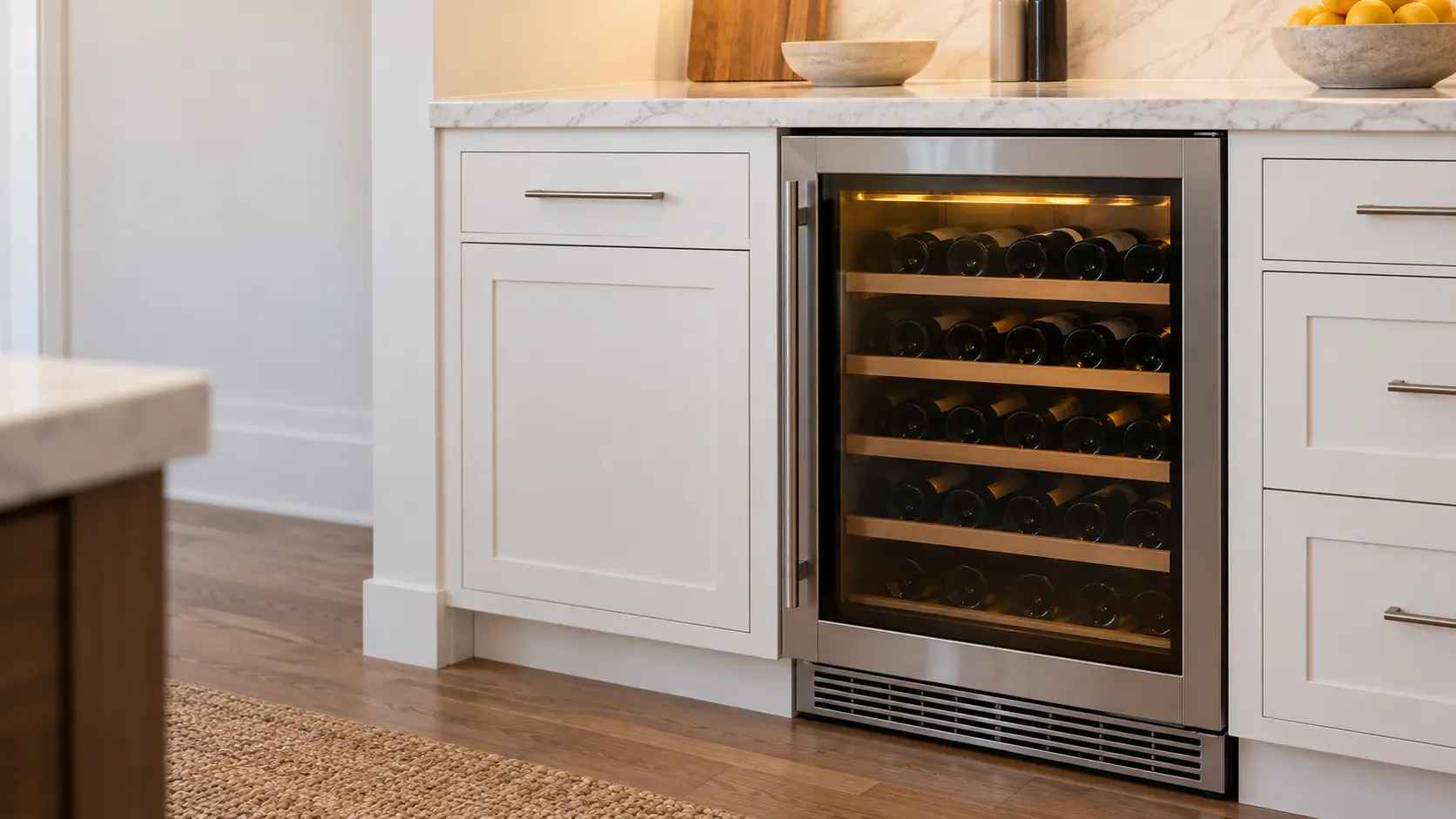
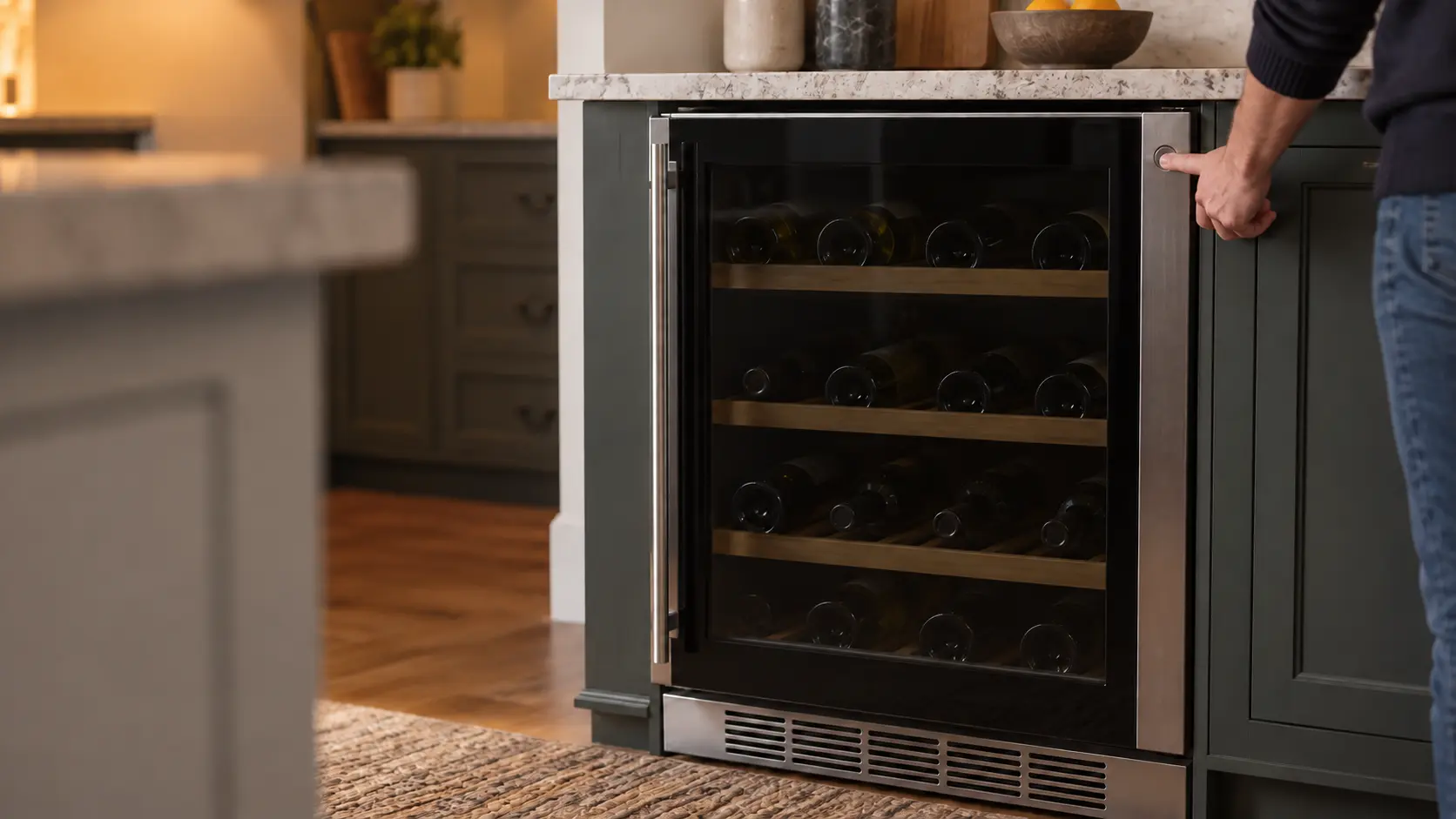
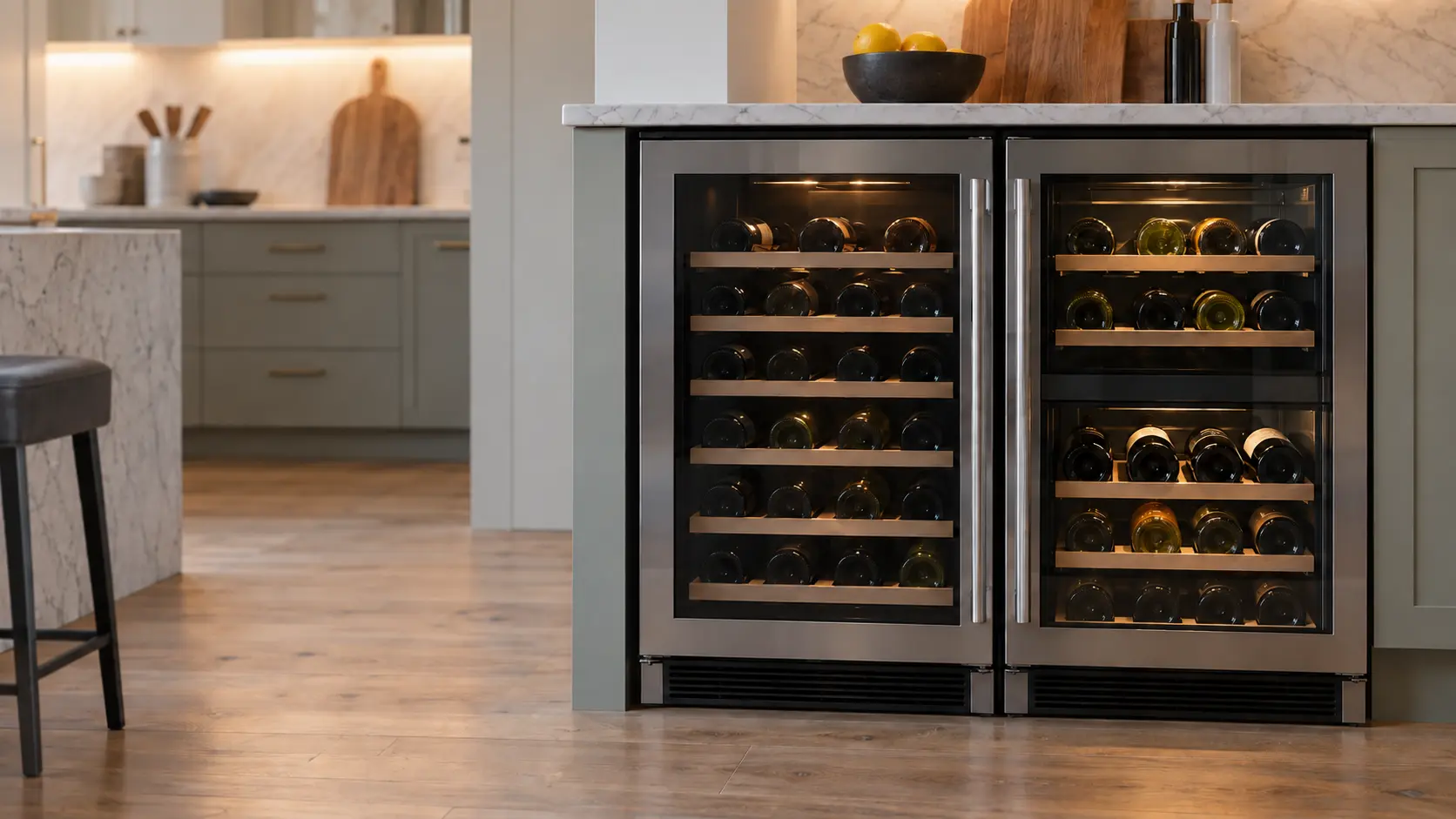
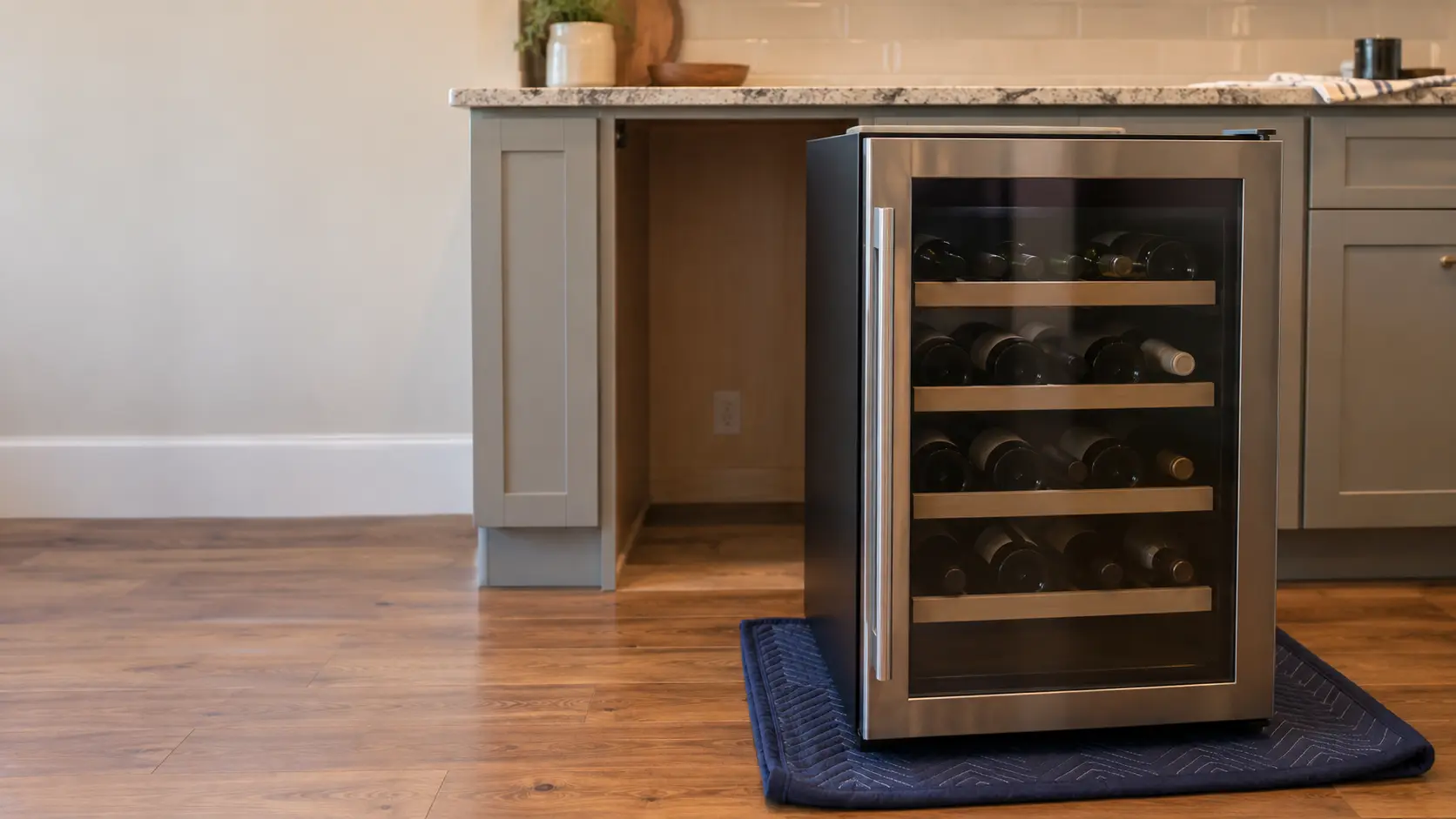
Undercounter wine cooler
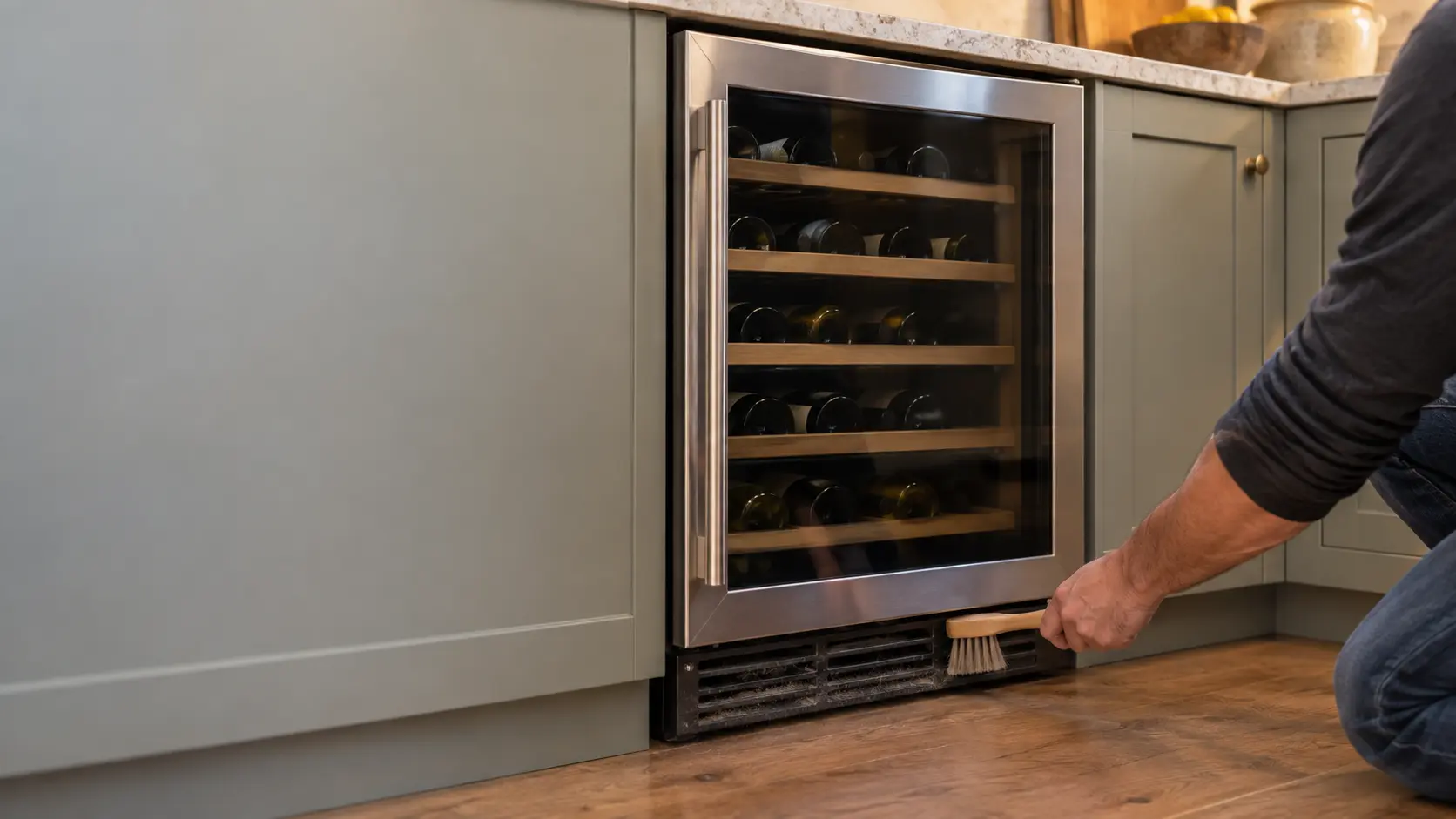
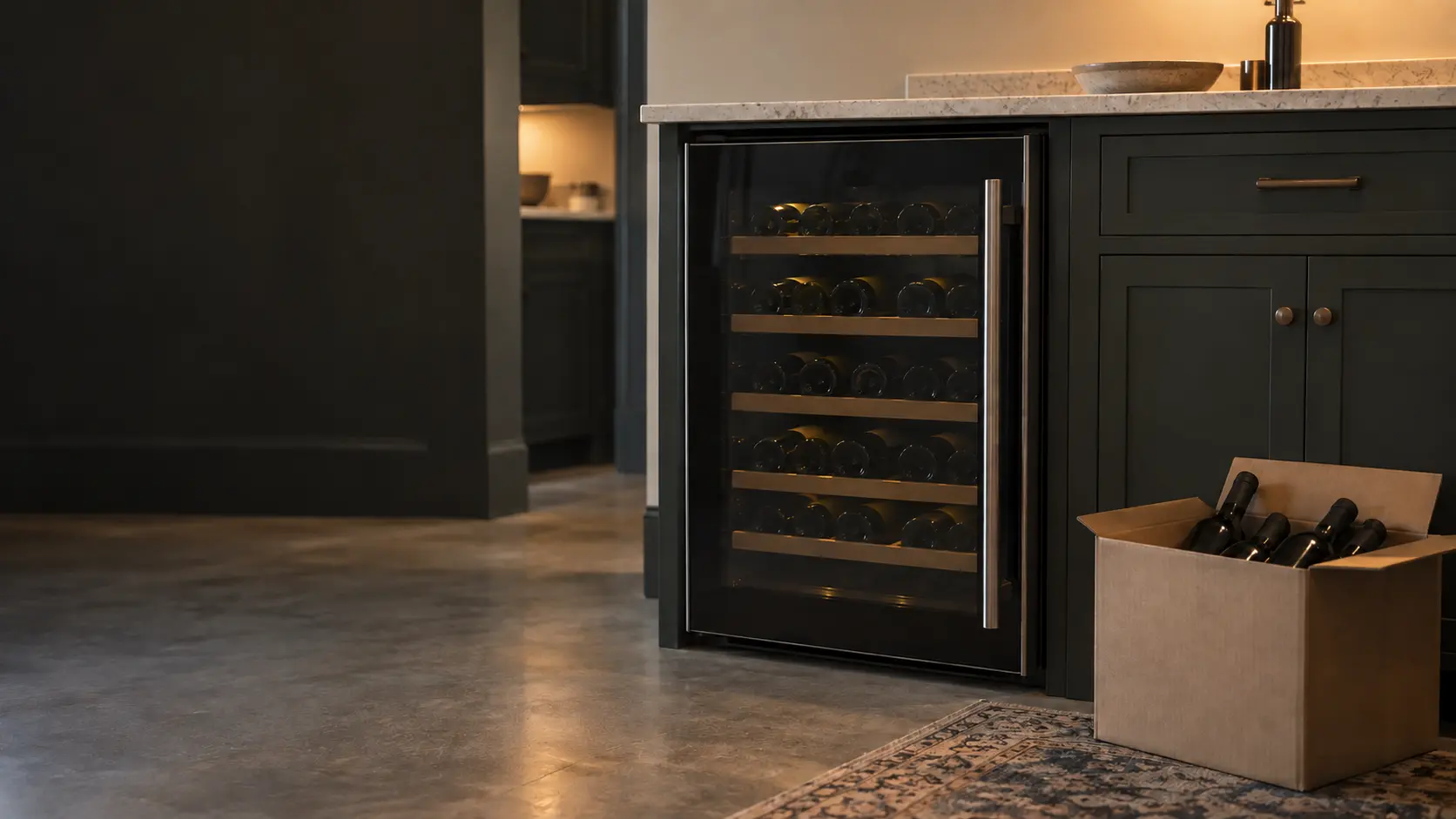
A wine cooler about the height of a base cabinet, built in under the counter of a kitchen, a bar or a butler's pantry, with a glass door, sliding racks and a vented toe grille at the floor.
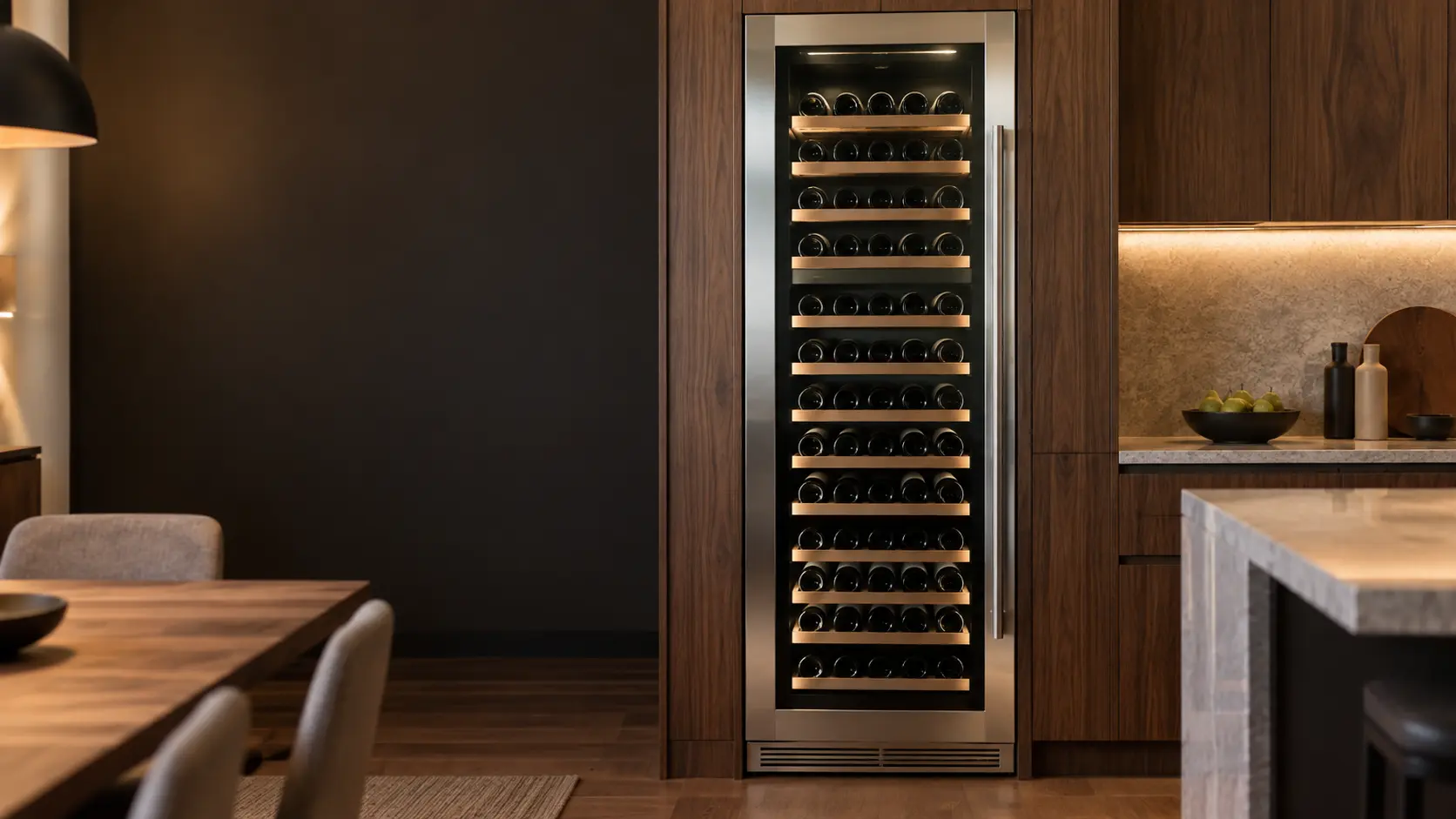
Wine column
A full-height built-in wine cabinet, 18 to 30 inches wide, set flush into tall cabinetry or paired with a matching column, with a glass or panel door and dozens to well over a hundred bottles inside.
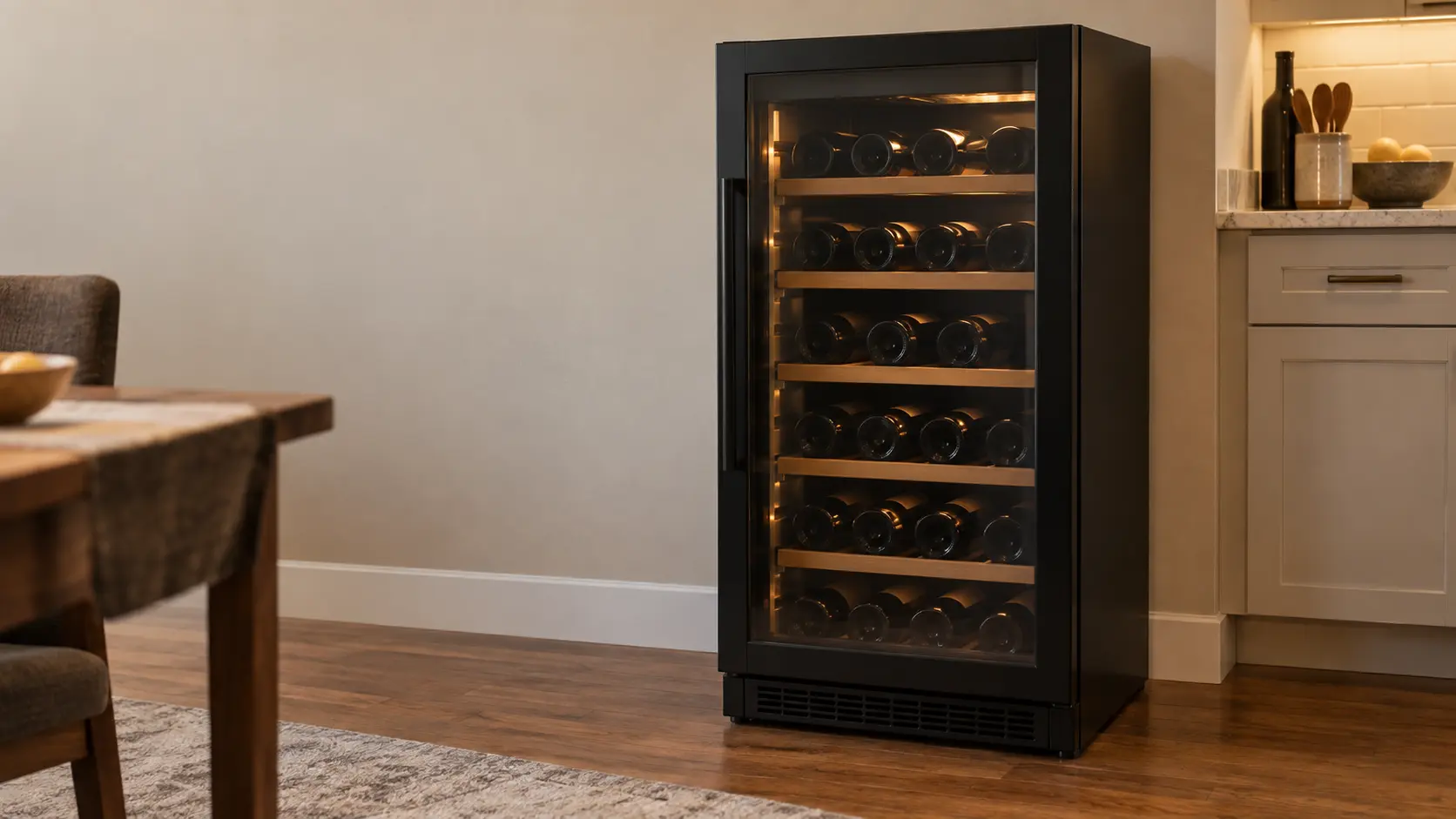
Freestanding wine cooler
A wine cooler that stands on its own in a dining room, a den or a basement, cooled either by a compressor or by a thermoelectric module, and vented at the back or the sides.
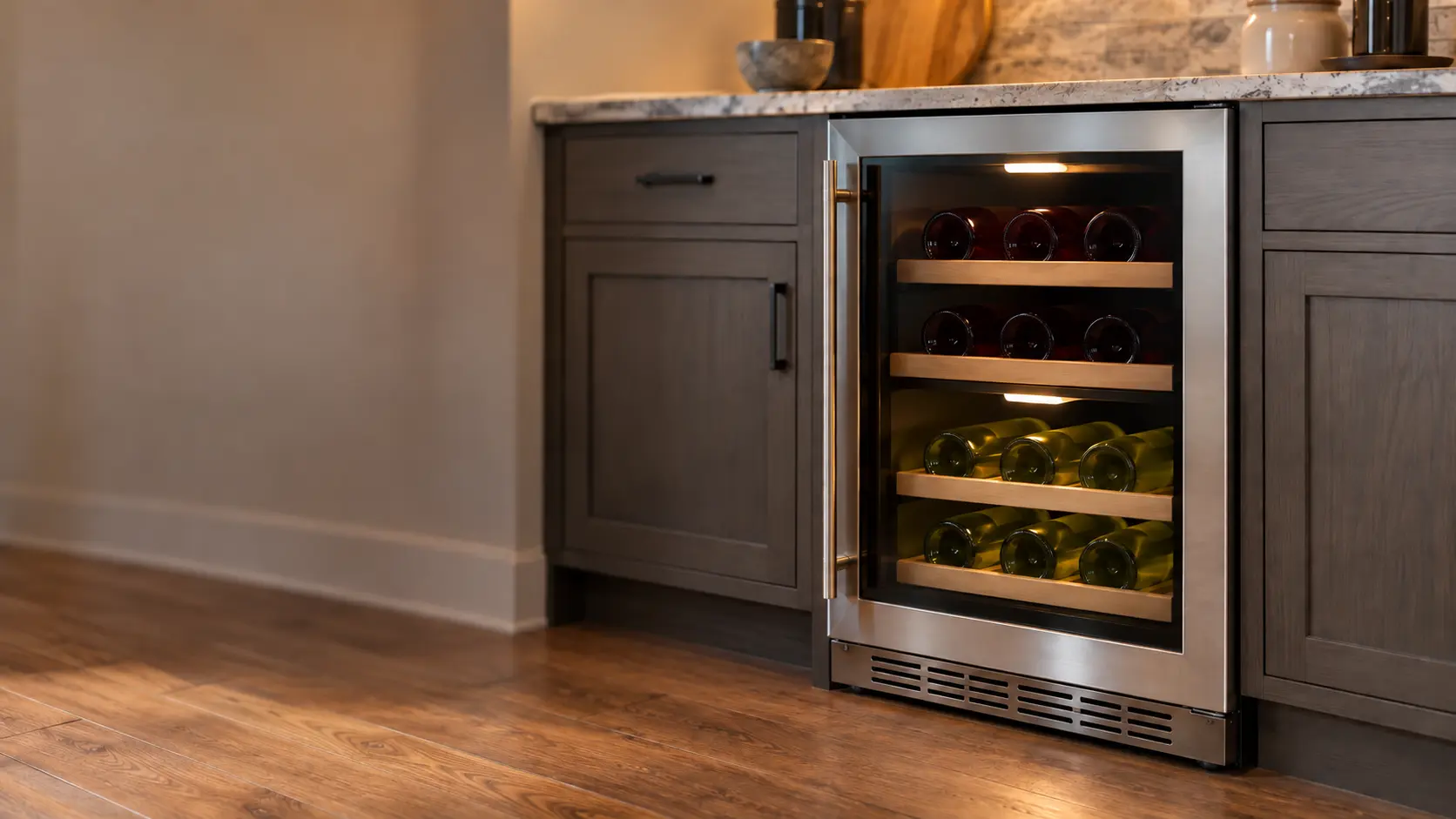
Dual-zone wine cooler
A wine cooler with two separately set compartments, upper and lower or side by side, so reds and whites or a storage zone and a serving zone each keep their own temperature.
Every kind we serviceAll wine coolers, side by side
The archive puts the 4 types against each other: how to tell which you own, what fails on each, and which manufacturers build them.
How to tell yoursWhat fails on eachWho makes them Open the type archiveA bottle that pours at cellar cool.
A glass door that stays clear.
Perhaps the reds feel warm to the hand, the glass door clouds over every afternoon, one zone of a dual-zone unit has drifted, or the cabinet buzzes loud enough to hear from the next room. Begin with the latest thing you noticed; every page starts with what it likely means for the bottles and only later mentions a visit.
 All 17 problems
Wine Cooler Not Cooling
A wine cooler not cooling rarely announces itself: the glass feels warm to the touch, a bottle lifted from the middle rack is nearer to room temperature than to cellar temperature, and the display may still show the number you set.
Wine Cooler Leaking Water on the Floor
A wine cooler leaking water leaves a puddle at the toe kick or under the front edge, a wet cabinet floor beneath the lowest rack, or a slow trail along the base of the counter that you only notice when a sock gets wet.
Burning Smell From a Wine Cooler
A wine cooler burning smell, hot plastic or scorched insulation drifting from the grille at the base or from the back of the cabinet, sometimes with a buzz, a click, a flicker of the interior light or a dark display, calls for the power to go off before anyone thinks about the wine.
Wine Cooler Tripping Breaker or GFCI
A wine cooler tripping breaker or GFCI outlet leaves the cabinet dark and silent; a reset brings it back, and hours or days later it drops out again while the bottles inside slowly warm.
Wine Cooler Not Turning On
A wine cooler not turning on shows a dark display, no interior light, no fan and no hum; the cabinet sits silent, sometimes after a power outage and sometimes after a long press of the wrong key.
Wine Cooler Too Cold for the Wine
A wine cooler too cold for its bottles shows up as whites that pour numb and flavorless, reds that taste closed, a thermometer in the 40s where you set 55°F, and in the worst case a cork nudged up by wine that has begun to freeze.
Familiar brands. Expert care.
For the brands
in your home.
Independent repair service. Not affiliated with, authorized or endorsed by any manufacturer. Brand names and model numbers are the property of their respective owners and are used here for identification only, to describe the appliances we service.
What a repair
usually costs.
Measure a repair against two things: a new cabinet for the same opening, and the bottles now inside. Nearly every fan, sensor, gasket, drain or hinge job is a small share of either. Built-in columns and undercounter units almost always earn their repair, sealed-system work included, since a replacement must fit the cutout and match its neighbors. On a small, older freestanding cooler the line falls at a failed compressor, a refrigerant leak or a second thermoelectric module, and there the technician sets both numbers side by side.
| Repair | Relative cost | Notes |
|---|---|---|
| Start relay, compressor or sealed-system leak | moderate to highest | A start relay or overload on a compressor-cooled cabinet is a small part changed from behind the grille. A leak that has to be brazed, with a new drier, a vacuum and a weighed charge, or a new compressor, sits near the top of the scale. |
| Thermoelectric module, fan or power supply | low to moderate | The solid-state module, its two fans and the low-voltage power supply are modest parts reached from the back panel. Most of the time goes into cleaning the heat sinks and seating the new module evenly. |
| Circulation or condenser fan motor | low to moderate | A fan motor is an affordable part reached from the inside rear wall or behind the grille. A variable-speed fan in a column, or a fan behind a zone full of racks, adds a little time. |
| Thermostat or zone temperature sensor | low to moderate | A single sensor or a dial thermostat is an inexpensive part. A column with a sensor in each zone, where more than one has drifted, moves the job up a step. |
| Main control board, display board or door switch | moderate to highest | A door switch, a connector or a board fuse is a small repair. A main board or a touch display for a built-in column is one of the costliest parts a wine cooler takes, and some have to be ordered in. |
| Door gasket, hinge adjustment or glass door | low | A gasket made for the model, fitted with the door in place, sits low on the scale. A full glass door or frame to replace a pane that has fogged between its layers costs more than a gasket alone. |
| Damper, damper motor or zone fan | moderate | The damper and its motor sit behind the rear panel of the zone they feed, so the racks come out first. Ice in the air channel from a leaking door adds time for thawing and curing the leak. |
| Drain hole, drain tube or drip tray | lowest | Clearing and flushing the drain, or reseating a tray over the compressor, is among the least costly work on a wine cooler. A cracked tray under a built-in unit, reached by sliding it out, adds a little. |
| Rack slides, rack fronts, hinge or interior lights | low | Slides, wood fronts, hinges and LED strips are affordable parts made for each model and fitted with hand tools. An LED driver board or a full set of racks for a tall column sits a little higher. |
9 metros,
one appliance.
A wine cooler's surroundings set its workload: a kitchen that heats up every summer afternoon, a sunny dining room where the light falls across the glass, a basement bar that stays humid, a coastal home where storms take the power, a condo with the unit boxed into tight cabinetry. Each note describes what a town or a neighborhood asks of the wine coolers in it, rather than describing the town.
All service areasTampa BayFL · 31 areas
Tampa Bay wine coolers sit in kitchens, lanai bars and dining rooms of houses without basements. Helene and Milton in 2024 flooded the coast and cut power for days, summer storms bring lightning almost daily, and humidity fogs a glass door as soon as its seal weakens.
OrlandoFL · 30 areas
Orlando wine coolers turn up in lakeside bars, family kitchens and the game rooms of vacation rentals, where one set of guests after another changes the settings. Afternoon storms flicker the power through most of the summer, and Ian in 2022 and Milton in 2024 left houses dark for days.
Miami / South FloridaFL · 47 areas
South Florida wine coolers live with heat, humidity and hurricanes: rooms kept for comfort sit well above cellar temperature, damp air fogs glass doors and loads the drains, and a storm can leave a cabinet without power for days. Towers hold slim columns and undercounter units, and many owners are away for months.
New York MetroNY · 75 areas
New York wine coolers are mostly undercounter and freestanding units in apartments, with built-in columns in renovated kitchens and brownstone cellars holding more. Radiators and summer heat waves work against cellar temperature, low voltage strains controls, and narrow stairs make repair the usual choice.
HoustonTX · 36 areas
Houston wine coolers work in homes where the air conditioning holds rooms near 75 degrees, well above cellar temperature, so the cooler runs hard for most of the year. Beryl in 2024 and the February 2021 freeze left collections without power for days, and floodwater reaches ground-floor bars on low ground.
ChicagoIL · 50 areas
Chicagoland wine coolers live in kitchens, in basement bars and, through the winter, in rooms colder than the cabinet's setting. Dry indoor heat hardens gaskets, humid summers load the drains, spring storms test the sump pumps under basement bars, and summer thunderstorms can leave a block dark overnight.
Los AngelesCA · 95 areas
Across Los Angeles a wine cooler may sit in a mild beach-town kitchen or in a Valley house that passes 100 degrees, where it works through every summer afternoon. Earthquakes make rack stops and anchored columns matter, wind-season shutoffs and the 2025 fires taught collectors to plan for days without power, and built-in columns fill remodeled kitchens.
San DiegoCA · 31 areas
San Diego's coast keeps rooms mild enough for quiet thermoelectric coolers, while inland valley houses heat up through the fall and need compressor units. Salt air works on hinges and racks near the shore, and public-safety shutoffs can cut the power in fire weather.
San Francisco Bay AreaCA · 74 areas
Bay Area collectors live close to wine country, and their homes carry built-in wine columns in Peninsula remodels, thermoelectric coolers in apartments without air conditioning and dual-zone units in home bars. Earthquakes make anchored cabinets and rack stops part of owning a wine cooler here, and public-safety power shutoffs in fire weather test how long a closed cabinet holds 55 degrees.

Answers before
you book.
When could a technician reach my wine cooler?
Is my kind of wine cooler one you repair?
How should I prepare for the wine cooler visit?
What does fixing a wine cooler usually cost?
My wine cooler is getting on in years. Should I still fix it?
My wine cooler is warming with bottles inside. What do I do first?
Work out what
you are dealing with.
Split by what you are trying to find out rather than by what part of the appliance it concerns.
All 18 guides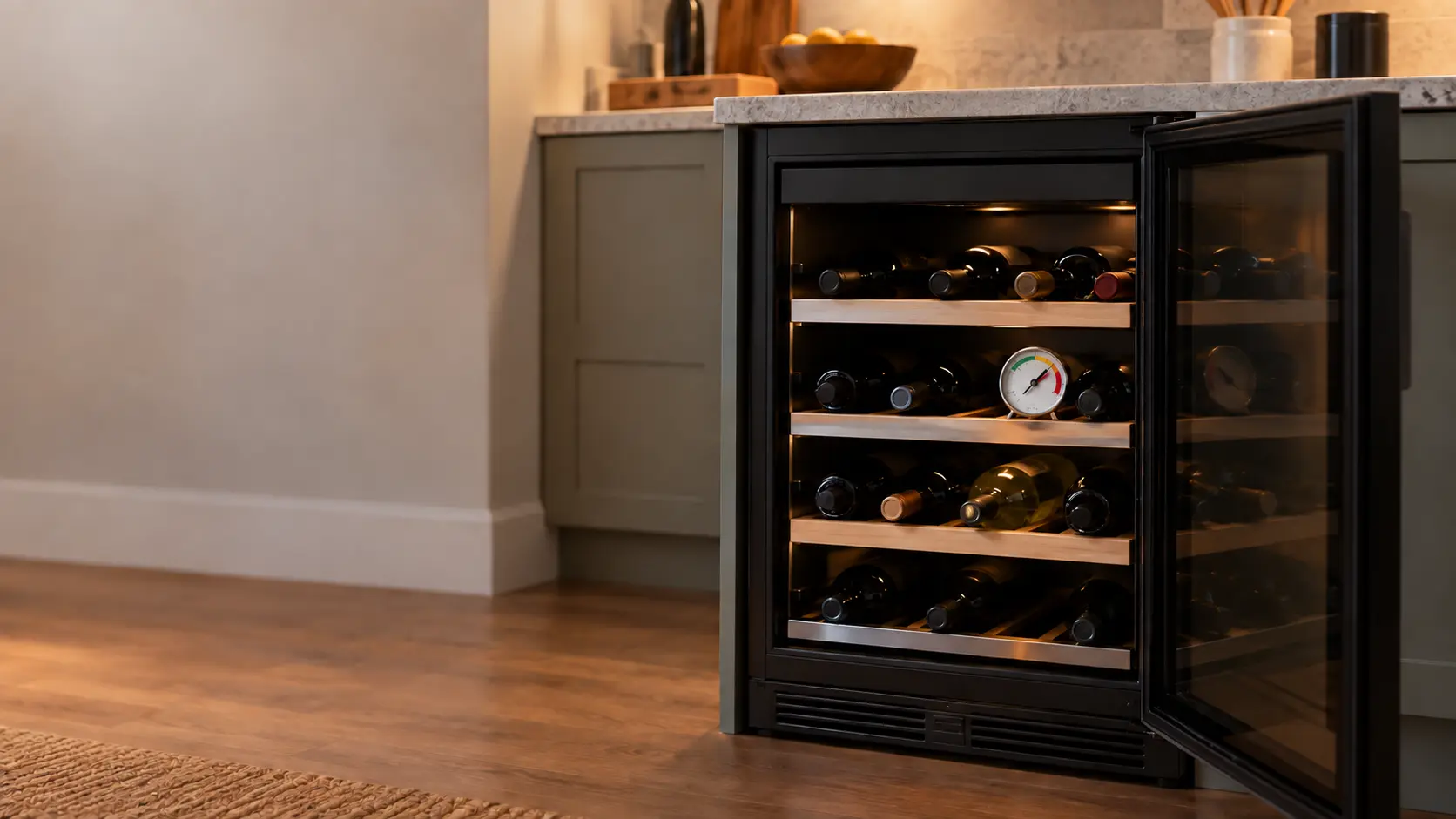
Curious what fixing the cooler might cost? The answer lives on its own page, since an honest figure only exists once the unit has been measured with the bottles inside — wine cooler repair cost.
Back to your everyday
Let’s get your wine cooler working again.
Three short steps, a window that suits you, and a price for the actual repair before any work starts.