
Freestanding Wine Cooler Repair
A wine cooler that stands on its own in a dining room, a den or a basement, cooled either by a compressor or by a thermoelectric module, and vented at the back or the sides.
Mon–Sat, 8am–8pm
- 4 things that fail on it
- 9 makes build it
- 6 problems it shows
Book a visit
Three short steps, about a minute.
or call (844) 709-0727
Loading appointment form…
The appointment form couldn’t load. Please try again.
Is yours
a freestanding?
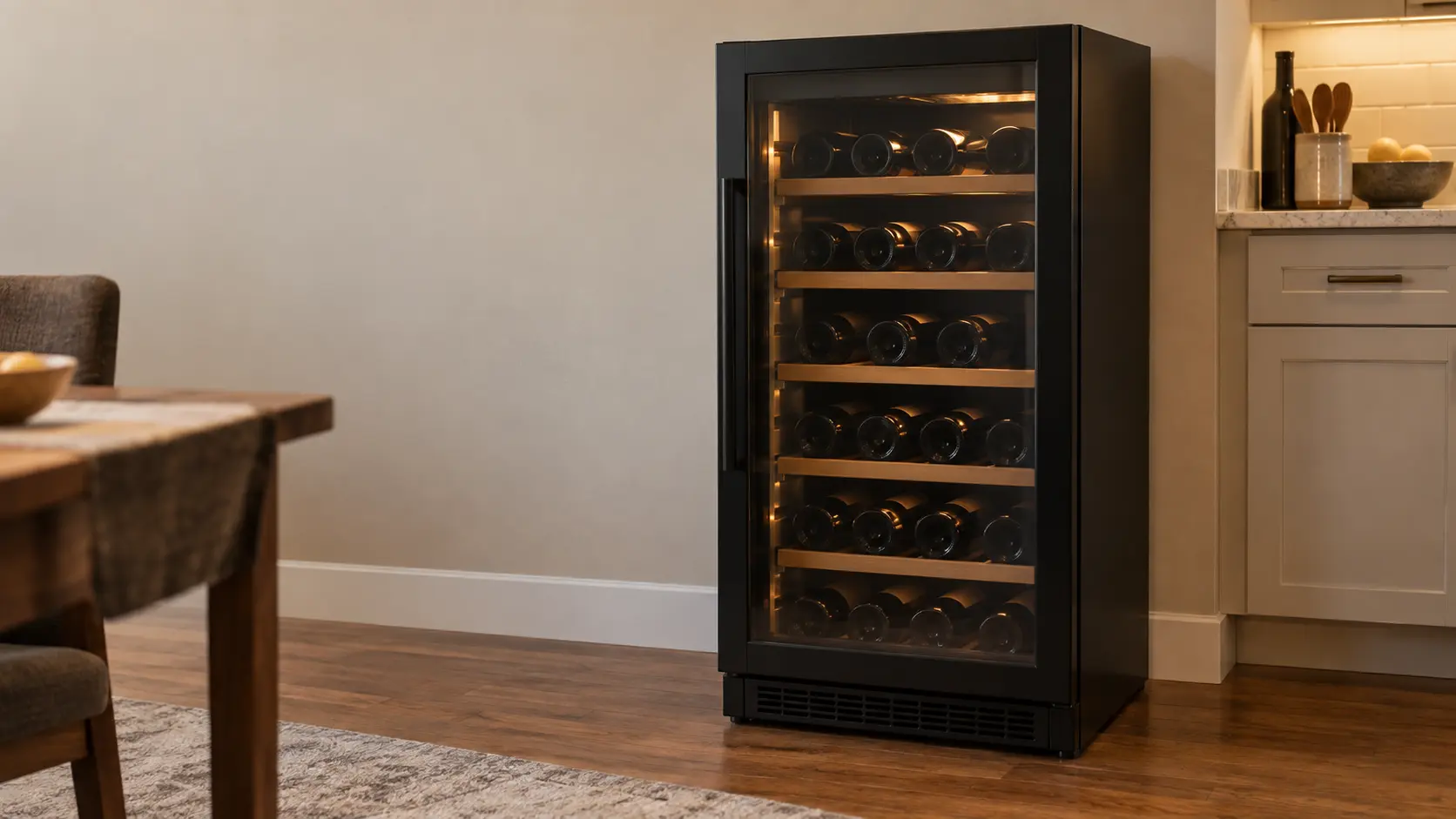
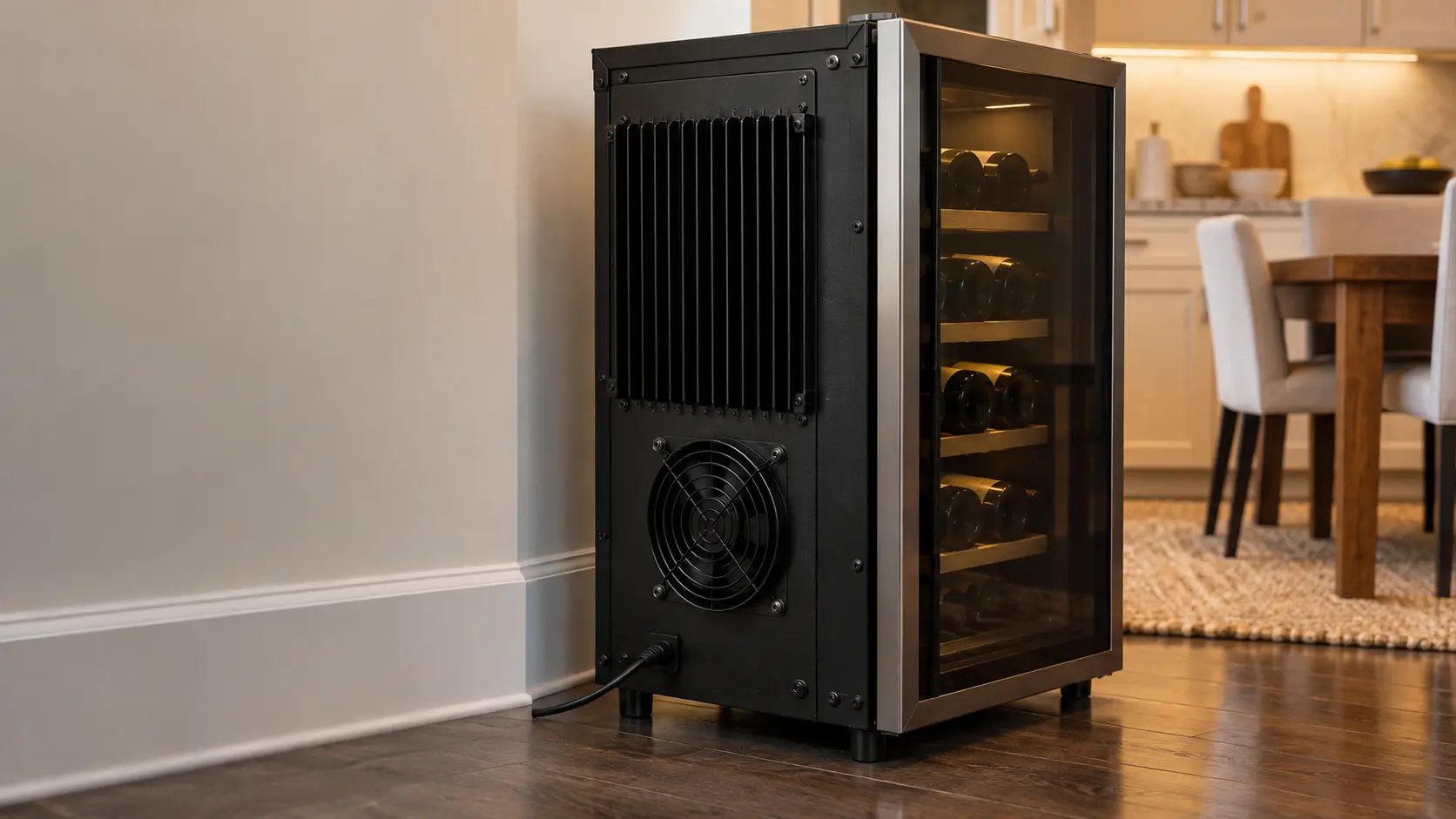
A freestanding wine cooler is a finished cabinet with its own sides and top, made to stand against a wall rather than inside cabinetry. It comes in two very different kinds. A compressor model works like any cooling appliance, with a sealed system, a compressor near the floor and a condenser at the back, and it holds a cellar temperature even in a warm room. A thermoelectric model has no compressor at all: a solid-state module moves heat from a cold plate inside to a heat sink outside, with a fan on each side, which makes it quiet and free of vibration but limits how far it can cool below the room. Most small freestanding units, from 12 to 50 bottles, are thermoelectric, and many of their problems start with a fan or with a room that is simply too warm for them. A visit begins by learning which kind it is and how warm the room gets.
 What fails on a freestanding wine cooler
How to tell
It has finished sides and a finished top, stands away from cabinetry, and needs a few inches of open space behind it or around it.
A compressor model has a black dome and coils at the lower back; a thermoelectric model has neither, only a finned heat sink and a fan behind a grille.
A thermoelectric unit is nearly silent and you can rest a hand on it without feeling any hum; a compressor model cycles on and off with a low sound.
The racks are often wire or thin wood shelves, and the controls are a simple pair of buttons or a small display on the door frame or the top.
Not yours?Undercounter wine coolerWine columnDual-zone wine cooler
What fails
on this design.
On a freestanding wine cooler: a thermoelectric fan that stops, a room too warm for the cooling method, vibration from the compressor, door seal and hinge on a light cabinet.
The problems it showsA thermoelectric fan that stops
Both fans in a thermoelectric unit have to run for the module to work: the inside fan spreads the cold, the outside fan clears the heat. When either one fails, the cabinet climbs toward room temperature within a day while the display stays lit.
A room too warm for the cooling method
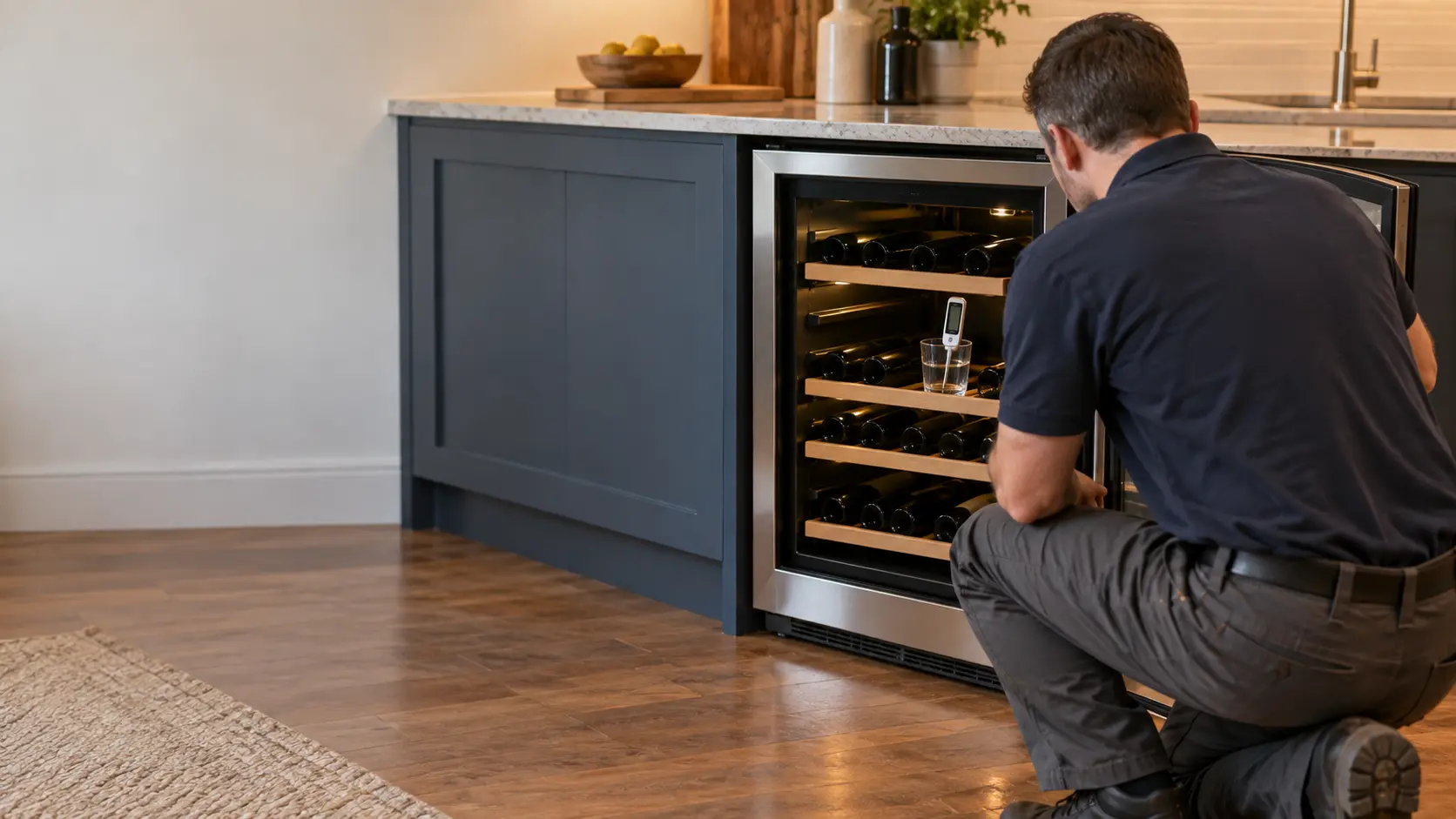
A thermoelectric unit can cool only so far below the air around it, often about 20 to 25 degrees. In a sunny room or a basement near a furnace in summer, it runs flat out and still cannot reach its set point, which looks like a failure but is a limit.
Vibration from the compressor
On a compressor model, worn rubber mounts or a tubing loop that touches the cabinet pass a hum into the racks. Constant vibration is what wine is kept away from, and it is often a small repair at the back.
Door seal and hinge on a light cabinet
A smaller cabinet with a glass door is light enough to rock when the door opens, and the seal and hinge take the strain. A door that no longer pulls shut lets humid air in, which shows as water on the glass and a musty smell.
Getting at it,
and whether to.
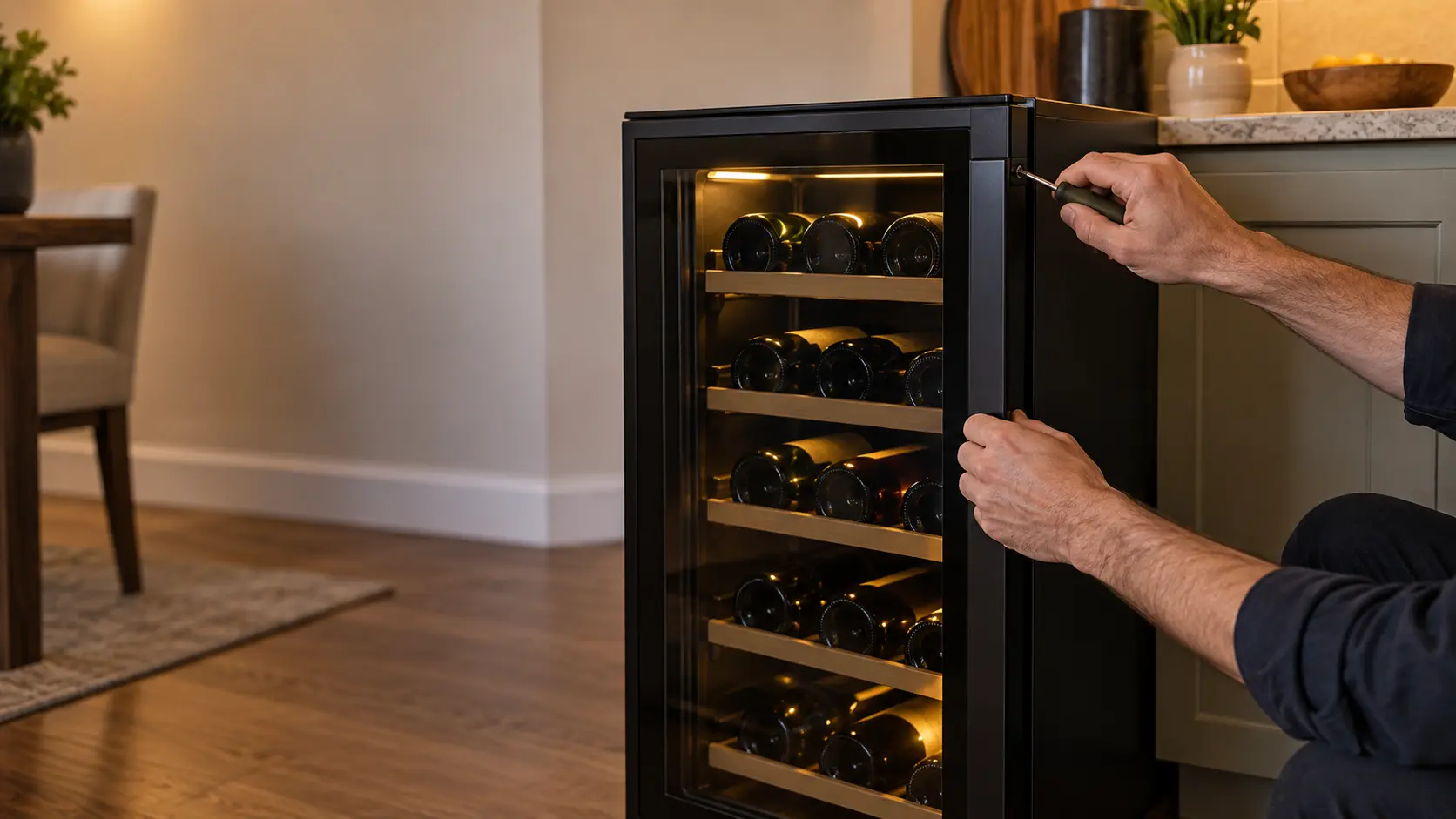
A freestanding unit is usually easy to reach: it is pulled forward a foot or two so the back, the heat sink and the fans can be opened.
What repairs costOn the visit
- Clear a path and the outlet behind it, and take the bottles out onto a towel on the floor, lying down, if the cabinet has to be moved or tipped.
- Note how warm the room gets during the day, and whether the cooler stands in sun, near a heating vent or beside another appliance that gives off heat.
- Keep the door shut and the bottles in place until the technician arrives, unless the cabinet is already at room temperature.
Repair or replace
On a compressor model, fans, sensors, controls, gaskets and hinges are all worth repairing, and the line falls only at a sealed-system failure on an older, low-cost unit. A thermoelectric cooler is different: its module, fans and power supply are modest parts and a repair is often sensible, but a small cabinet that has already had a module and a board replaced may cost nearly as much to fix again as to replace. The technician tells you plainly which side of that line your cooler sits on.
Book a visit for a freestanding wine coolerThe problems
it shows.
On a freestanding wine cooler, most often wine cooler not cooling.
All problems
Wine Cooler Not Cooling
6 causes, cheapest first
Wine Cooler Noisy or Vibrating
5 causes, cheapest first
Condensation on a Wine Cooler Glass Door
5 causes, cheapest first
Wine Cooler Fan Not Running
5 causes, cheapest first
Wine Cooler Smells Musty
6 causes, cheapest first
Wine Cooler Not Turning On
5 causes, cheapest first
Who builds
a freestanding.
9 of the makes on this site build a freestanding wine cooler. Each mark opens that make's own page.
All 25 brandsFreestanding wine cooler repair,
where we come out.
9 metros, each with its own page.
All service areasTampa BayFL · 31 areas
Miami / South FloridaFL · 47 areas
New York MetroNY · 75 areas
HoustonTX · 36 areas
ChicagoIL · 50 areas
Los AngelesCA · 95 areas
San DiegoCA · 31 areas

Questions about
freestanding wine coolers.
How do I know if my freestanding wine cooler is thermoelectric?
My thermoelectric wine cooler will not get below 60°F in summer. Is it broken?
Can a freestanding wine cooler be built into a cabinet?
Why does my freestanding wine cooler hum through the bottles?
Back to your everyday
Is it a freestanding wine cooler?
Say so when you book — it changes what the technician brings and how the visit is planned.