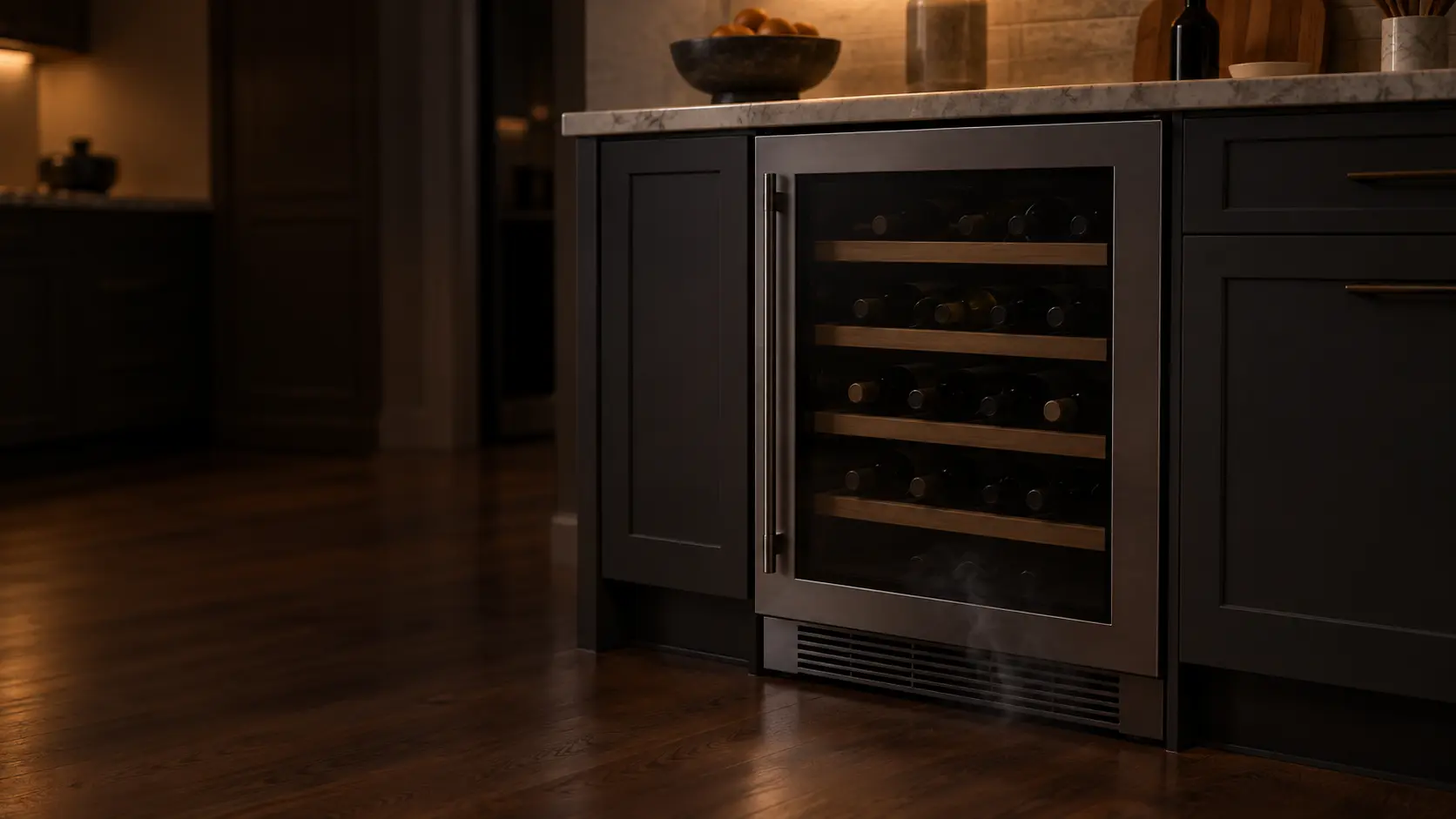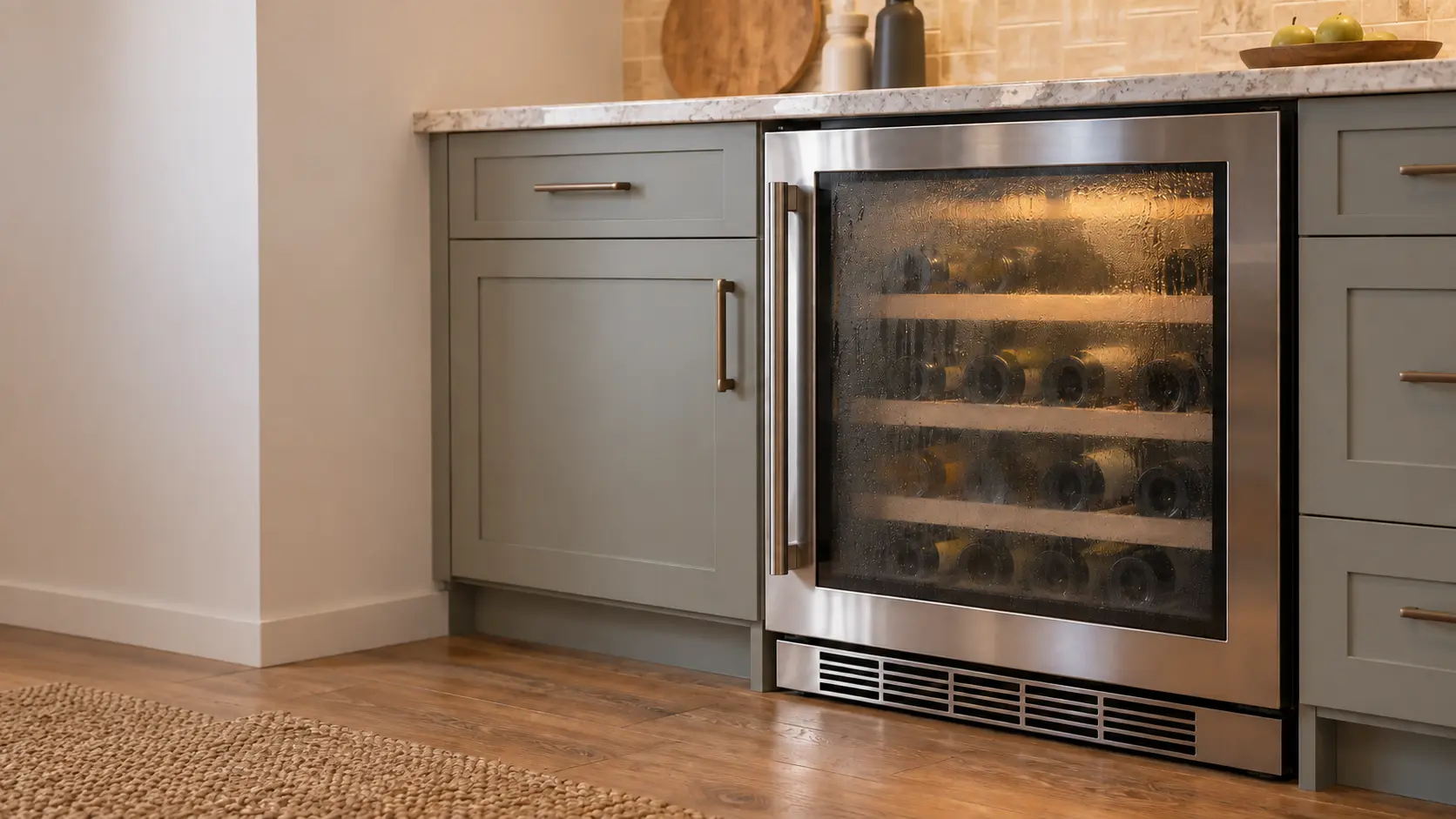
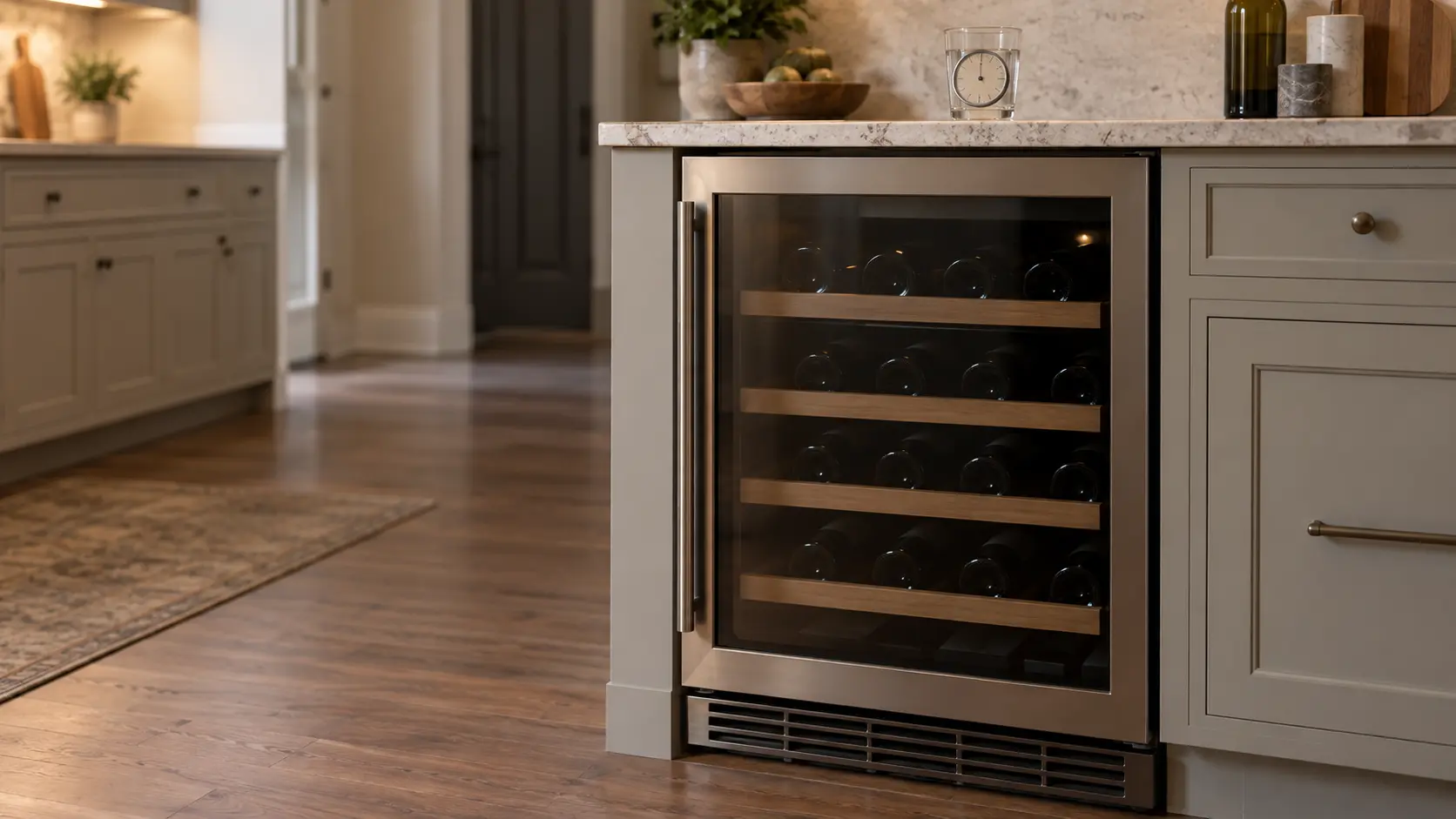
A wine cooler with its glass door fogged with condensation, the bottles blurred behind it.

Start with the symptom

Wine cooler
problems,
symptom first.

Every symptom we are called out for, traced to the causes that actually explain it — cheapest first. Start from what you are seeing rather than from what you think is broken.

(844) 709-0727

Mon–Sat, 8am–8pm

  • 17 symptoms
  • 4 need a visit now
  • Causes in cost order

Book a visit

Three short steps, about a minute.

or call (844) 709-0727

Needs a visit now

Four situations lead this list because the wine or the house is exposed: bottles warming in their racks, water edging toward an outlet, a hot plastic or scorched smell, and a cooler that throws its breaker again and again. Leave the glass door closed while you read: a shut cabinet full of bottles changes temperature slowly, and every look inside hurries it along. If the visit is a day or more away, carry the bottles you would least like to lose to the coolest dark corner of the house, lying on their sides. Where water has reached an outlet, keep your hands and feet out of it; if power has to be cut, do it at the breaker panel, standing on a dry floor away from the cooler.

Wine at risk now

Wine Cooler Not Cooling

A wine cooler not cooling rarely announces itself: the glass feels warm to the touch, a bottle lifted from the middle rack is nearer to room temperature than to cellar temperature, and the display may still show the number you set.

Causes, cheapest first

  1. A warm room or a boxed-in freestanding unitno repair
  2. Condenser fan or grille choked with dustlow to moderate
  3. Thermoelectric module or its fans worn outmoderate
All 6 causes and what to check
Wine at risk now

Wine Cooler Leaking Water on the Floor

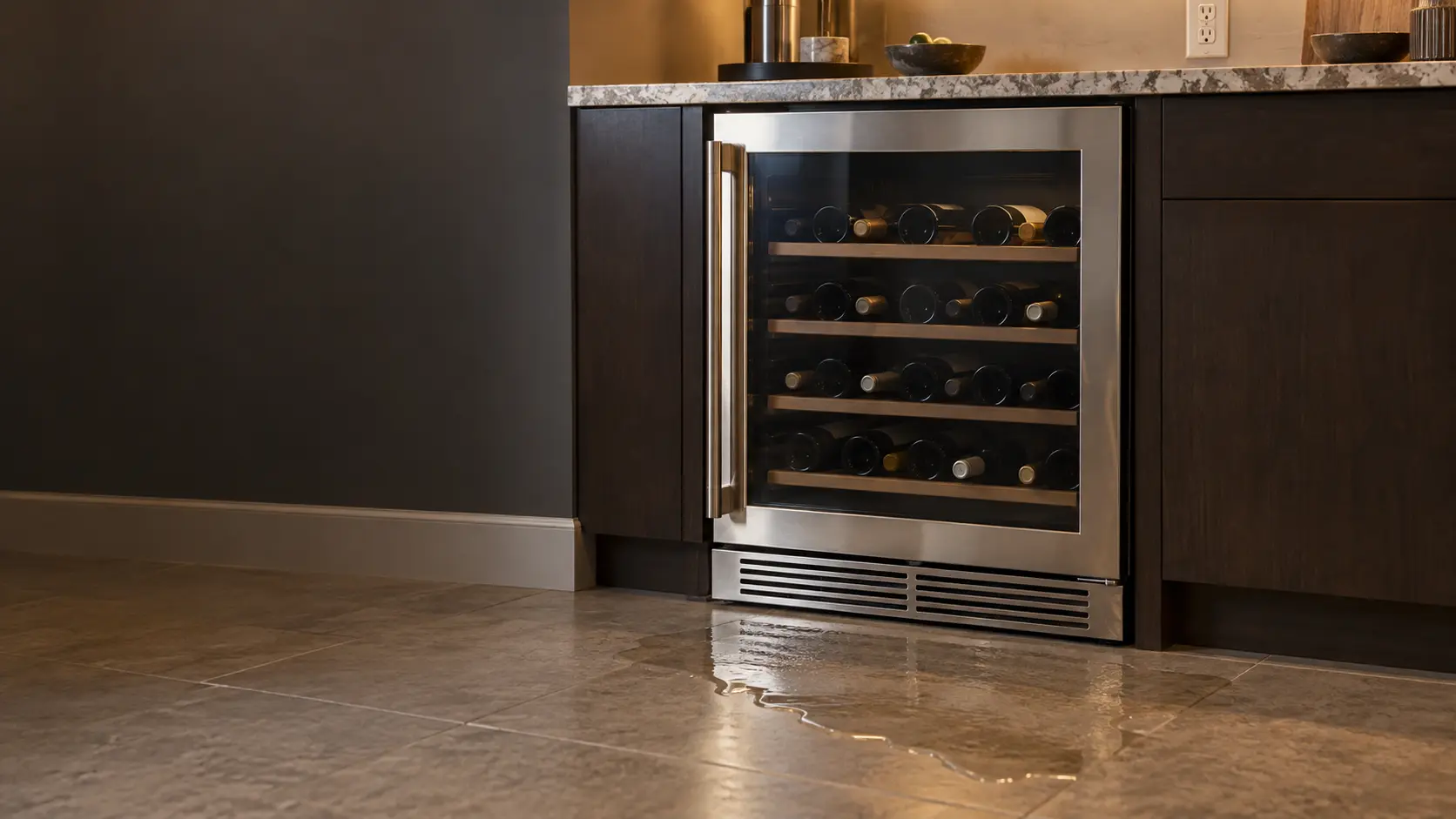
A wine cooler leaking water leaves a puddle at the toe kick or under the front edge, a wet cabinet floor beneath the lowest rack, or a slow trail along the base of the counter that you only notice when a sock gets wet.

Causes, cheapest first

  1. Drain hole under the cold plate cloggedlow
  2. Melt pan cracked or knocked out of placelow
  3. Cabinet leaning toward the doorno repair
All 5 causes and what to check
Wine at risk now

Burning Smell From a Wine Cooler

A wine cooler burning smell, hot plastic or scorched insulation drifting from the grille at the base or from the back of the cabinet, sometimes with a buzz, a click, a flicker of the interior light or a dark display, calls for the power to go off before anyone thinks about the wine.

Causes, cheapest first

  1. Start relay or overload burnedlow to moderate
  2. Condenser fan motor overheatinglow to moderate
  3. Control board or power supply scorchedmoderate
All 5 causes and what to check
Wine at risk now

Wine Cooler Tripping Breaker or GFCI

A wine cooler tripping breaker or GFCI outlet leaves the cabinet dark and silent; a reset brings it back, and hours or days later it drops out again while the bottles inside slowly warm.

Causes, cheapest first

  1. Compressor shorting as it startshighest
  2. Water reaching a connectorlow
  3. Fan motor or wiring insulation wornlow to moderate
All 5 causes and what to check

Everything else we are called out for

With these the bottles are still resting cool and steady, so a regular appointment is fine. Each page lists what an owner can look at while the cooler carries on holding the bottles.

Wine Cooler Not Turning On

A wine cooler not turning on shows a dark display, no interior light, no fan and no hum; the cabinet sits silent, sometimes after a power outage and sometimes after a long press of the wrong key.
5 causes

Wine Cooler Too Cold for the Wine

A wine cooler too cold for its bottles shows up as whites that pour numb and flavorless, reds that taste closed, a thermometer in the 40s where you set 55°F, and in the worst case a cork nudged up by wine that has begun to freeze.
5 causes

Wine Cooler Temperature Swings

Wine cooler temperature swings show on a thermometer as a cabinet that reads 52°F in the morning and 62°F by evening, or as a display that keeps changing its number, while the bottles age unevenly behind the glass.
5 causes

One Zone Warm in a Dual-Zone Wine Cooler

One zone warm in a dual-zone wine cooler looks like this: the white-wine section holds 45°F while the red section drifts into the 60s, or the upper zone follows its setting and the lower one ignores it.
5 causes

Wine Cooler Running Constantly

A wine cooler running constantly never goes quiet: the compressor hums or the thermoelectric fans whir hour after hour, the grille at the base feels warm, and the power bill creeps up while the cabinet may or may not hold its setting.
6 causes

Wine Cooler Noisy or Vibrating

A wine cooler noisy enough to hear across the room, with a rattle from the grille, a buzz through the counter, bottles that clink against each other or a hum that has turned into a grind, is more than an annoyance for the wine inside.
5 causes

Condensation on a Wine Cooler Glass Door

Condensation on a wine cooler glass door fogs the view of the bottles: droplets bead on the outside of the glass on humid days, or a mist forms inside along the bottom edge and around the frame.
5 causes

Frost or Ice on the Back Wall of a Wine Cooler

Wine cooler ice buildup starts as a white bloom on the plate at the back of the cabinet and grows into a sheet of ice that reaches the rear bottles, blocks the drain channel and melts into puddles under the bottom rack.
5 causes

Wine Cooler Door Not Sealing

A wine cooler door not sealing drifts back open an inch, closes without its soft pull, or leaves a gap you can see at one corner of the gasket, while the glass fogs or the cabinet runs longer than it used to.
5 causes

Wine Cooler Display Not Working

A wine cooler display not working may be blank, dim, stuck on one number, flickering or deaf to every touch of the keys, while the cabinet itself may still be cooling quietly behind the glass.
5 causes

Wine Cooler Fan Not Running

A wine cooler fan not running leaves the cabinet air still: no soft breeze when the door opens, a warm top rack over a cold bottom one, and on a thermoelectric model a heat sink at the back that grows hot to the touch.
5 causes

Wine Cooler Smells Musty

A wine cooler that smells musty greets you with a damp basement odor when the door opens, sometimes with gray spots on the labels, a sour note from a leaked bottle or a film of mildew on the wooden racks.
6 causes

Wine Cooler Error Code

A wine cooler error code appears as letters and digits on the display, a flashing temperature, dashes where a number should be or a blinking symbol, sometimes with an alarm tone and sometimes while the cabinet stays perfectly cool.
7 causes

Not every wine cooler
breaks the same way.

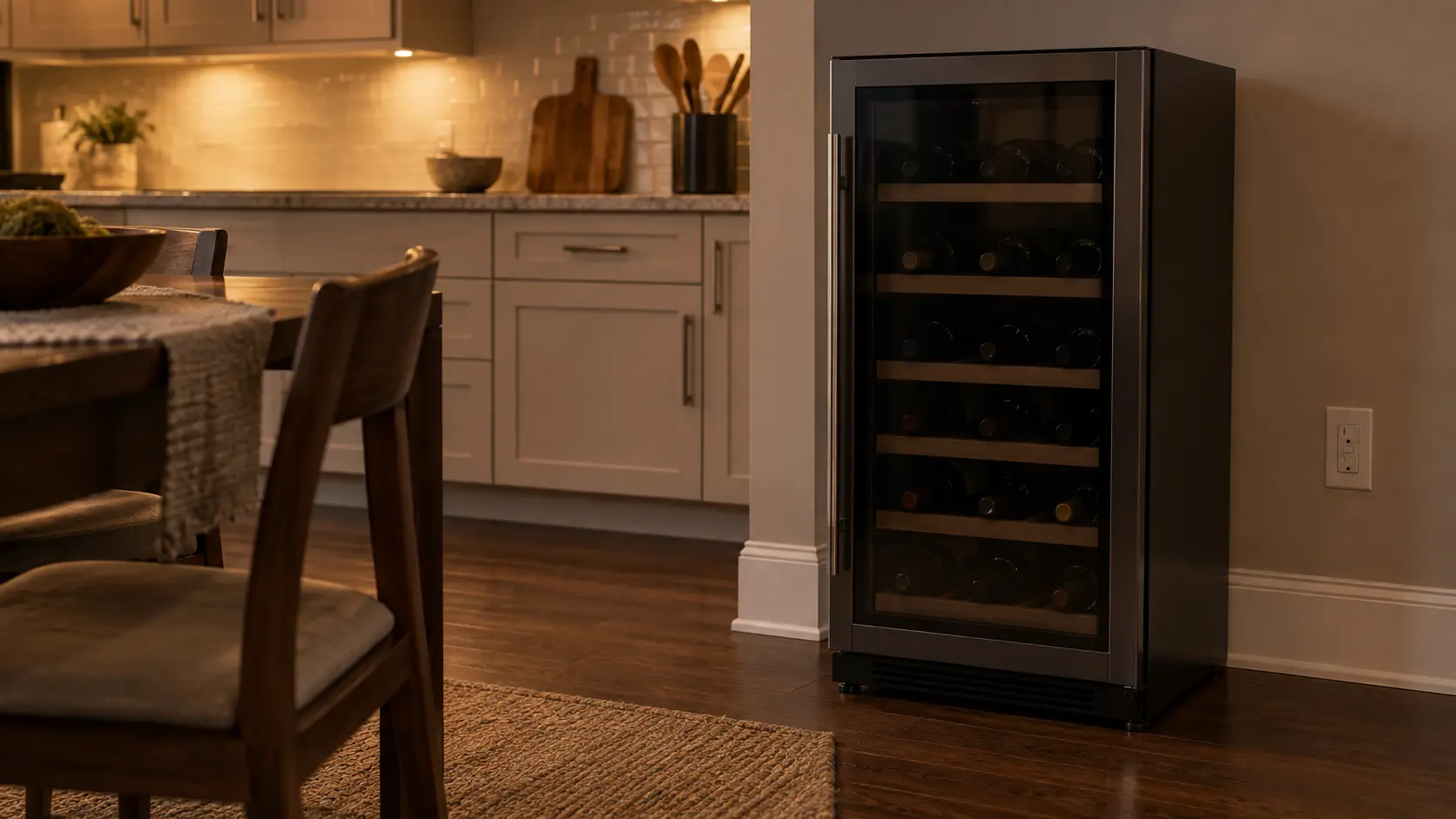
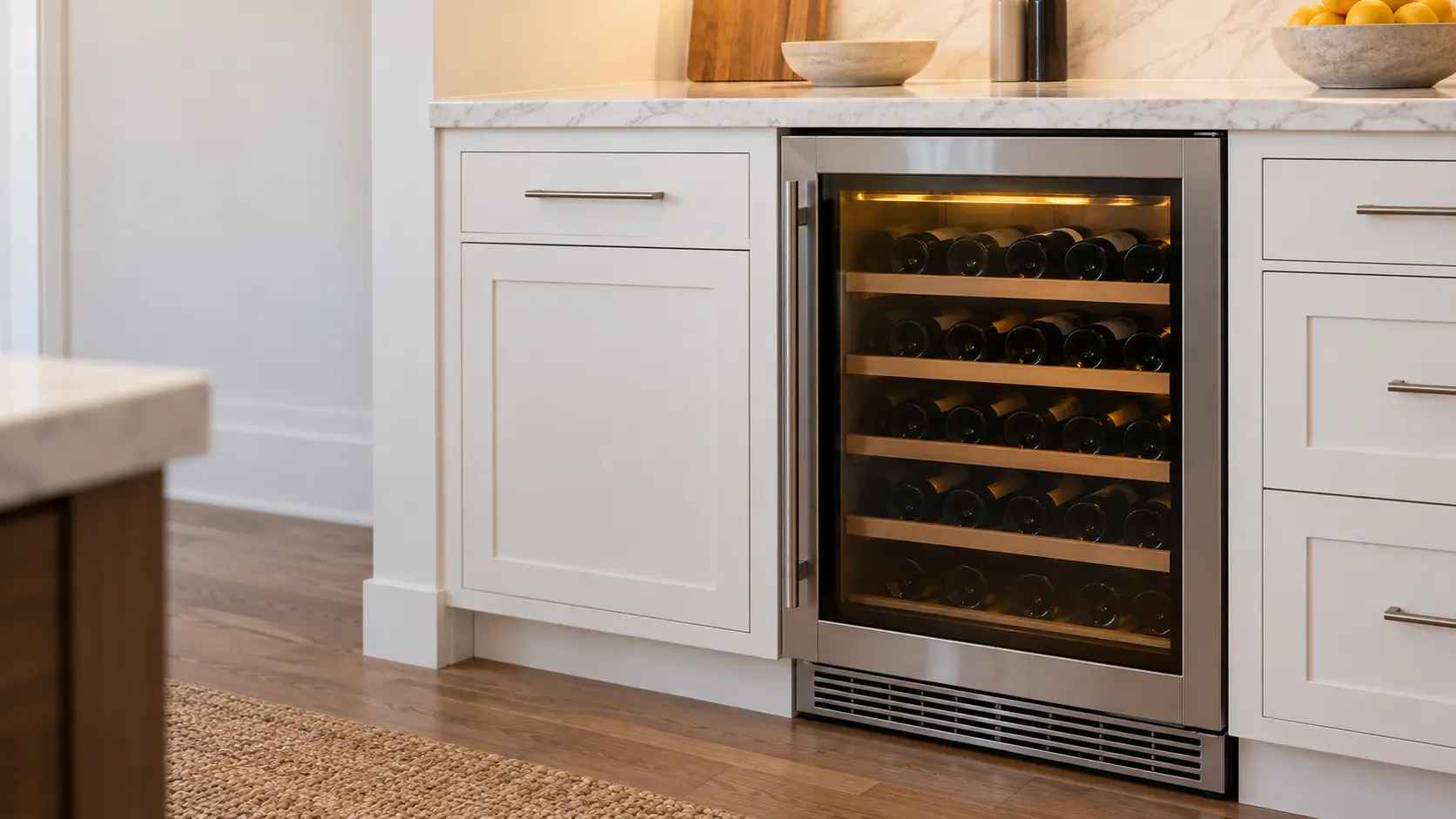
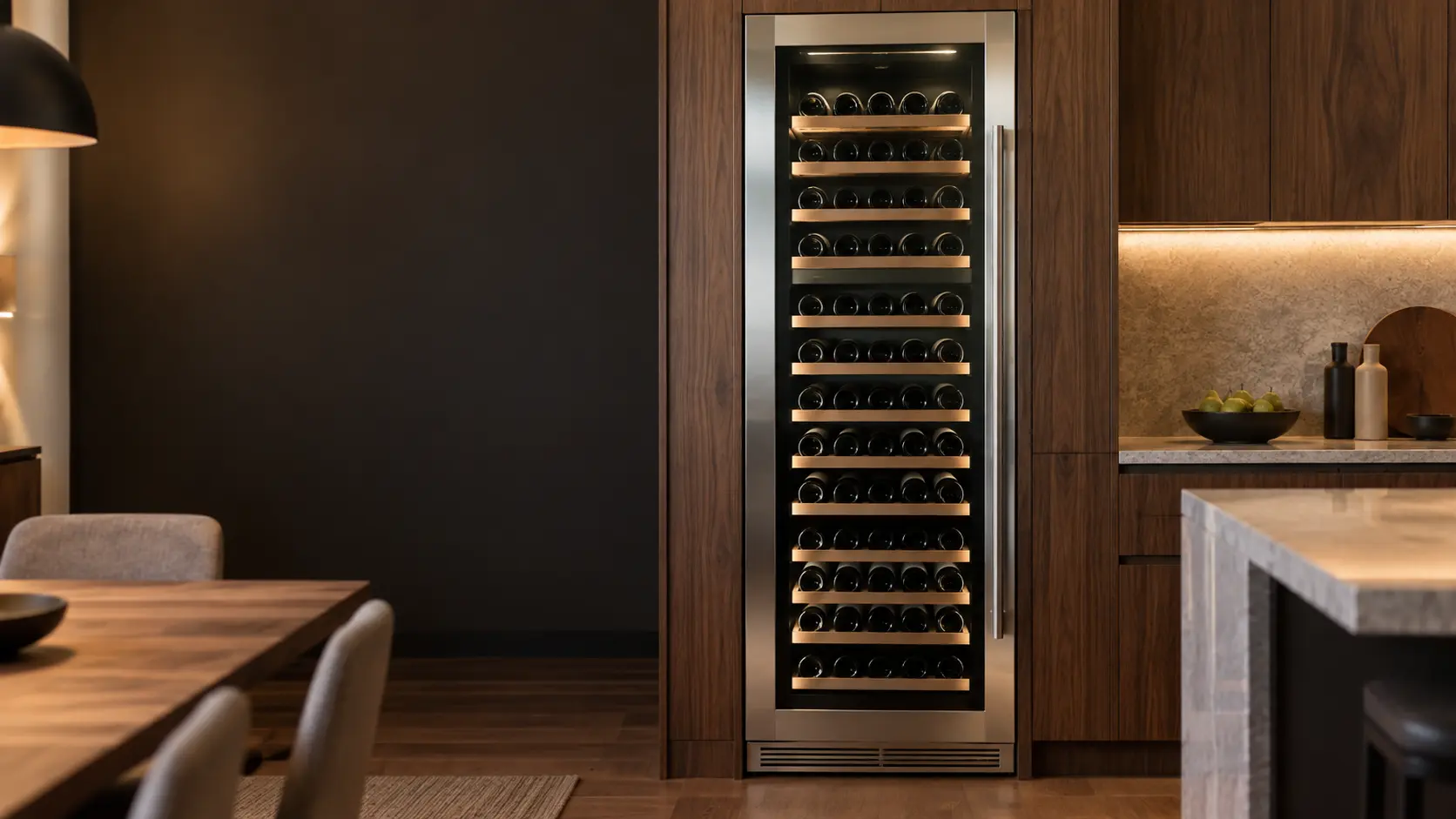
An undercounter wine cooler slides beneath the counter and breathes through a grille at the toe kick, a wine column stands at full height flush with the cabinets, a freestanding unit sits on its own with space around it and may cool with a compressor or a thermoelectric module, and a dual-zone cooler keeps reds and whites at two settings behind one door. Which of the four holds your bottles?

All wine cooler types

Familiar brands. Expert care.

For the brands
in your home.

Independent repair service. Not affiliated with, authorized or endorsed by any manufacturer. Brand names and model numbers are the property of their respective owners and are used here for identification only, to describe the appliances we service.

The repairs behind the symptoms

Most people arrive knowing what they are seeing, not what is wrong. These are the jobs a visit usually turns out to be.

diagnostic

Wine cooler diagnostic visit

A visit that measures each zone and the room around the cabinet first, then works through the door seal, the airflow, the sensors and the cooling system until one part is named.

moderate to highest

Wine cooler compressor and sealed system repair

Getting a compressor-cooled wine cooler holding cellar temperature again, from the start relay and overload that fail first to a leak or a restriction in the sealed tubing.

low to moderate

Wine cooler thermoelectric module repair

Bringing a thermoelectric wine cooler back to temperature by testing its solid-state module, the two fans on either side of it and the power supply that feeds them.

low to moderate

Wine cooler fan repair

Replacing the fan that circulates air across the racks, or the one that cools the condenser, when a wine cooler warms unevenly, ticks, buzzes or falls silent.

low to moderate

Wine cooler thermostat and sensor repair

Testing and replacing the thermostat or the temperature sensors that tell a wine cooler when to cool, when the cabinet runs too cold, too warm or back and forth.

moderate to highest

Wine cooler control board and display repair

Repairing the electronic control and the touch display that run a wine cooler, from a blank screen or a code to keys that will not respond or a cabinet that will not start.

low

Wine cooler glass door and gasket repair

Replacing a torn or flattened gasket, resetting a door that no longer closes square, and repairing the glass door that keeps light, heat and humid air away from the bottles.

moderate

Dual-zone wine cooler damper and zone repair

Getting both zones of a dual-zone wine cooler back to their own settings by testing the damper, the zone fans and the zone sensors that share one cabinet's cold.

lowest

Wine cooler drain and condensation repair

Clearing the drain line and resetting the drip tray that carry away the water a wine cooler collects, when water pools inside, runs onto the floor or feeds a musty smell.

low

Wine cooler rack, hinge and lighting repair

Fixing the parts you touch every day on a wine cooler: rack slides that stick, wood fronts that crack, hinges that sag, and interior lights that flicker or go out.

A couple choosing a bottle together from an undercounter wine cooler in a warm kitchen at dusk
For the heart of your home.

Questions about
the problems.

What my wine cooler does is not described anywhere here. Can I still book?
Of course. We only write pages for the complaints that come in most often; the rest are booked just the same. A line in the notes about the noise, the smell, the fog or where the puddle forms gives the technician enough to begin.
Fog on the glass and warm bottles at the same time: which do I read about?
Read the page for the one you spotted first. On a wine cooler a door seal that slipped can fog the glass for weeks before the cabinet begins to warm, so the earlier sign is usually closer to the cause. Related problems are linked at the foot of every page.
When does a wine cooler problem need someone today?
When the collection is warming inside the cabinet, when water is spreading toward an outlet, when something smells of burning, or when the breaker will not stay on. Every problem page marks how urgent it is; a misted door, a louder hum or a dead rack light is fine until the booked day.
Has the wine been harmed if the cooler warmed up for a while?
Usually not from one slow, modest rise; sound bottles tolerate a short spell above cellar temperature far better than repeated swings or real heat. What to watch for is a cork pushed up from the neck or wine seeping around it, both signs that the bottle got hot enough to expand. Keep the door closed, let the cooler come back down, and drink any suspect bottles sooner rather than later.

Back to your everyday

Let’s get your wine cooler working again.

Three short steps online, or one call. Tell us what you are seeing and pick a window that works.

(844) 709-0727 Schedule a repair