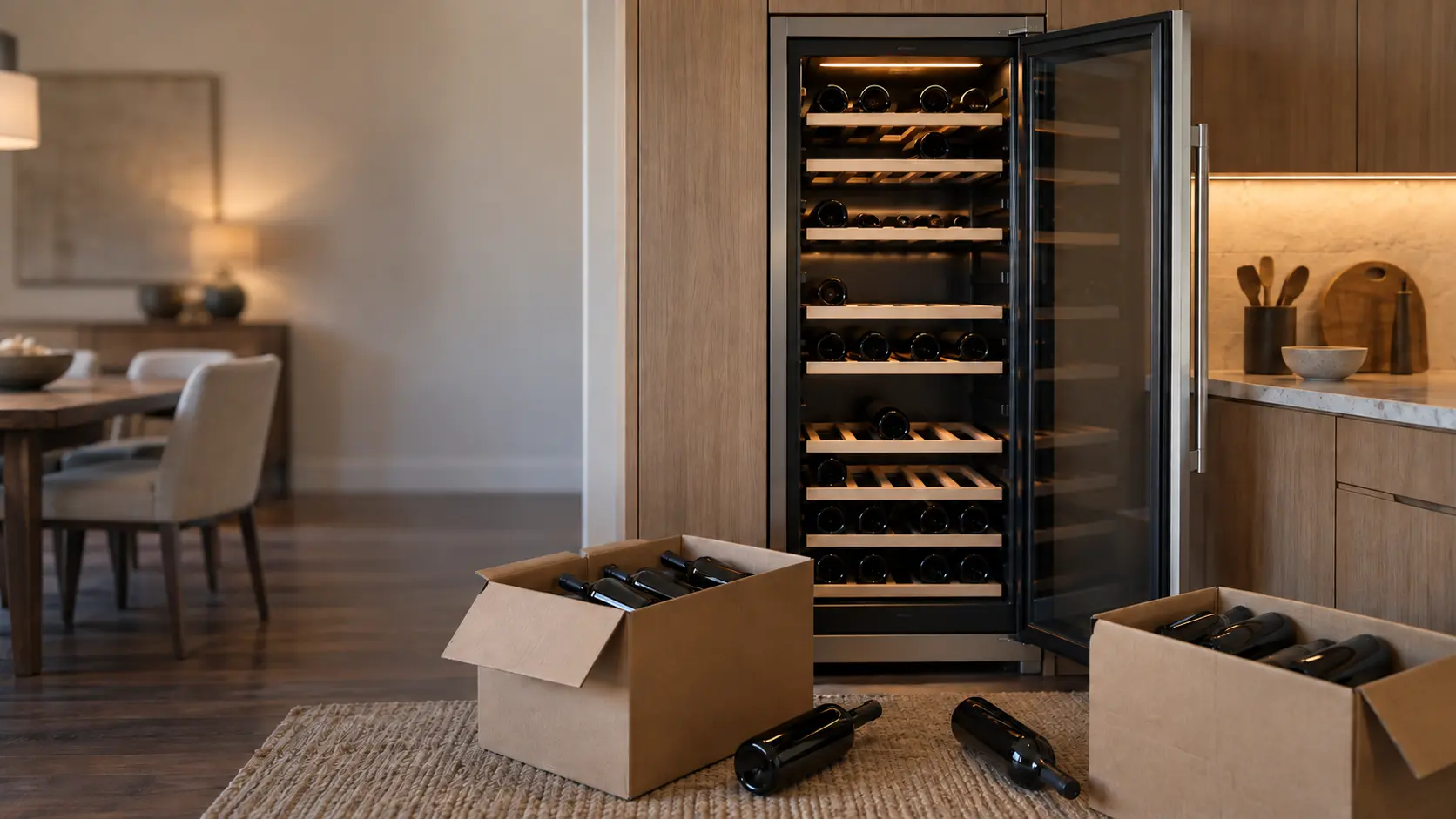
Deciding whether to move anything at all
Moving wine bottles exposes them to handling, light and a change of temperature, so the first question is whether the cabinet is actually a worse place than the alternative. A cooler that has stopped cooling in a 70°F house simply drifts to 70°F and stays there. Purdue Extension's wine storage table treats 75°F or below as acceptable for one to four weeks, so a repair booked for later this week usually does not justify emptying the rack.
The picture changes when the cooler sits in a room that gets hot, when the unit has gone the other way and is running without stopping, or when the repair will take a part that has to be ordered. Purdue sets the hard limit for heat at 86°F, and on the cold side it notes crystals after an hour at 32°F and freezing below 23°F for most table wines.
- Warm cabinet, cool room, repair within days: leave the bottles and keep the door shut.
- Warm cabinet in a room above 75°F: move the bottles you care most about today.
- Cabinet reading near or below freezing: unplug it and take everything out.
- Burning smell, sparks or water at the outlet: power off first, bottles second.
Source: Purdue Extension — Wine Storage Guidelines (FS-58-W) — Long-term storage 50°F to 60°F; 75°F or below for 1 to 4 weeks; never 86°F; crystals at 32°F and freezing below 23°F; below 50°F wine may not develop fully; condensation and mold on bottles moved from cold storage; corked bottles sideways or upside down; sparkling wine at about 90 psi
Where bottles wait out a repair
The best spot is the one whose temperature moves least over a day: an interior closet on the lowest finished floor, a basement storage room away from the furnace and water heater, the back of a guest-room closet on the north side. Purdue puts long-term storage between 50°F and 60°F, but for a few weeks steadiness matters more than hitting that number, and the table allows up to 75°F for that long.
Avoid anywhere with a view of the sun, anywhere next to laundry machines or a furnace, and every space outside the conditioned envelope. A garage, an attic, a car trunk or a covered porch will swing far more between noon and midnight than the kitchen the wine just left.
A friend's cabinet or a wine shop's storage
For a large or valuable collection facing a long wait, space in someone else's working unit is worth asking about. Carry the bottles in closed cases in the cabin of the car, not the trunk, and drive them straight there. Purdue's guidelines single out unrefrigerated delivery trucks in summer, often above 79°F, as a common place for wine to be damaged, and a parked car in the sun is no kinder.
The kitchen's own cold compartment
A few whites or sparkling bottles you plan to open this week can go into the kitchen's cold section without harm. The whole collection cannot: Purdue notes that below 50°F wine may not develop its full aroma and flavor, and bottles taken out of very cold storage gather condensation that can spread mold across labels and corks.
Source: Purdue Extension — Wine Storage Guidelines (FS-58-W) — Long-term storage 50°F to 60°F; 75°F or below for 1 to 4 weeks; never 86°F; crystals at 32°F and freezing below 23°F; below 50°F wine may not develop fully; condensation and mold on bottles moved from cold storage; corked bottles sideways or upside down; sparkling wine at about 90 psi

Carrying bottles without stirring them up
Purdue's guidelines ask for corked bottles, natural or synthetic, to be stored on their sides or upside down so the cork stays against the wine. For the few minutes of the move, lying bottles in the original case or a box with dividers on its side keeps that contact and stops glass knocking against glass. Screw-capped bottles are less fussy and can travel upright.
Take bottles off the racks one at a time and carry them the way they lay, label up. That keeps any sediment settled against the lower side and makes it easier to put each one back in its slot later.
Sparkling wine and heat
Champagne and other sparkling wines are bottled under pressure that Purdue gives as around 90 psi, and heat drives it higher. If the cabinet has already warmed, handle those bottles gently, keep them pointed away from faces, and move them early rather than last.
Bottles that come out cold and wet
Bottles carried from a cold zone into a humid room fog up at once. Let them dry on a towel before they go into cardboard, since wet cases soften and damp labels are where mold starts.
Source: Purdue Extension — Wine Storage Guidelines (FS-58-W) — Long-term storage 50°F to 60°F; 75°F or below for 1 to 4 weeks; never 86°F; crystals at 32°F and freezing below 23°F; below 50°F wine may not develop fully; condensation and mold on bottles moved from cold storage; corked bottles sideways or upside down; sparkling wine at about 90 psi
A record of what was where
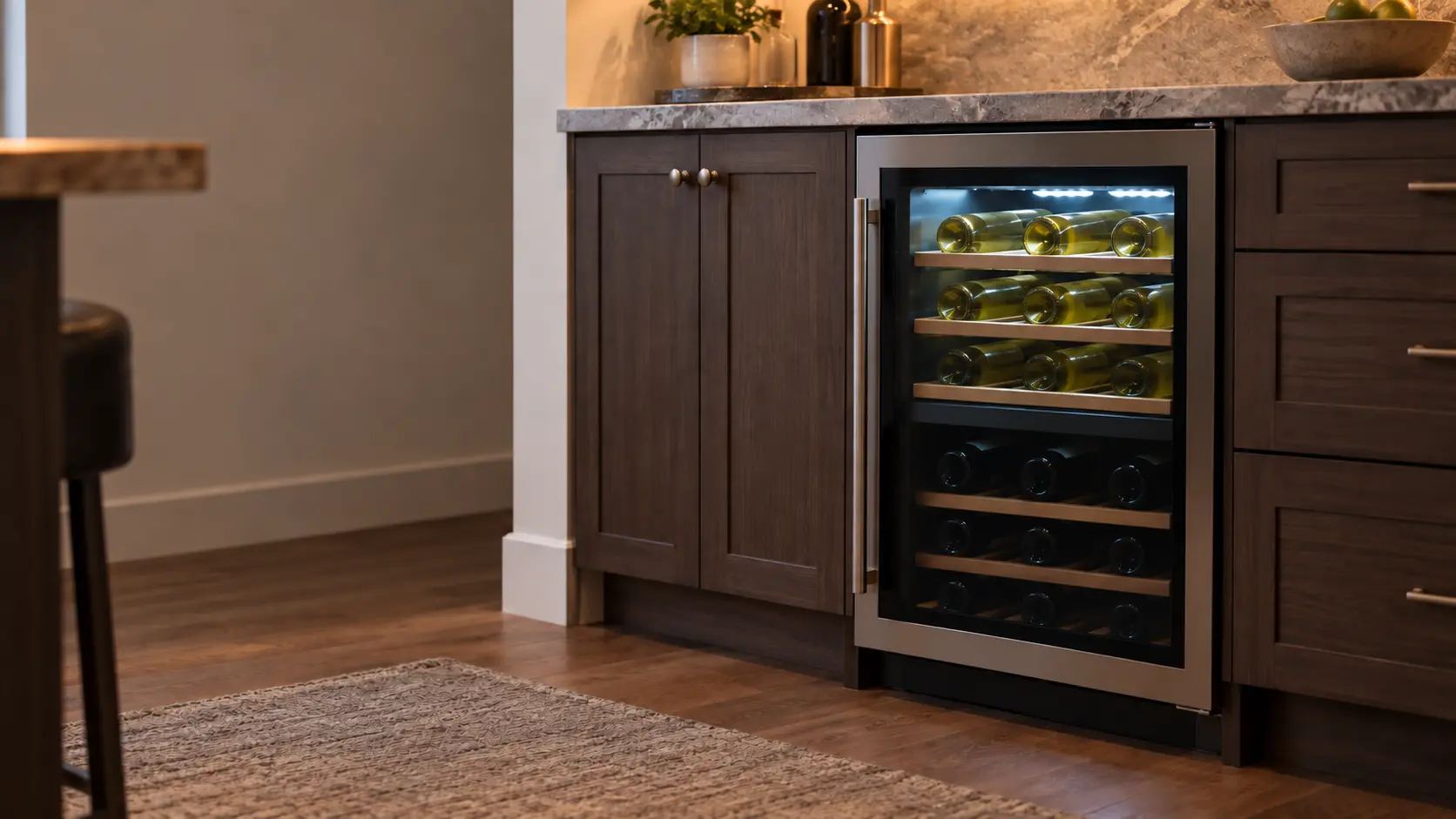
Before the first bottle comes out, take a photograph of each rack with the door open. It costs a minute and saves the evening of work that sorting a dual-zone cabinet from memory would take: reds from the upper zone, whites and sparkling from the lower one, the bottles set aside for a date or a gift.
Number the cases or boxes as you fill them and note which rack each came from. On a large column, a simple list on paper taped to the door is enough, and it also tells the technician how full the cabinet was when it failed.
- One photograph per rack, door open, before anything is lifted.
- Numbered cases, each marked with the rack or zone it came from.
- A paper list on the door: how many bottles, which zone, which ones matter most.
If the cooler itself has to move
Some repairs are easier with a freestanding unit pulled into the open, and a replaced cooler has to leave altogether. Zephyr's manual says never to move the unit with bottles inside, to secure the door closed, and to use at least two people. A full cabinet is much heavier than an empty one, and a glass door swinging open on a dolly is how bottles and fingers get hurt.
Keep the cabinet upright. Zephyr and Vinotemp both ask for a compressor unit to stand upright for 24 hours before it is plugged back in, so the oil in the compressor can settle; a cooler laid on its side for the trip needs that full day.
Source: Zephyr — Presrv Wine Cooler Use, Care and Installation Guide (PRW24C01AG) — Do not move the unit without removing the contents and securing the door; use at least two people; stand upright for at least 24 hours before plugging in; Vinotemp — Wine Coolers Frequently Asked Questions — Coolers must stand upright for 24 hours before being plugged in so the coolant can settle
Putting the collection back
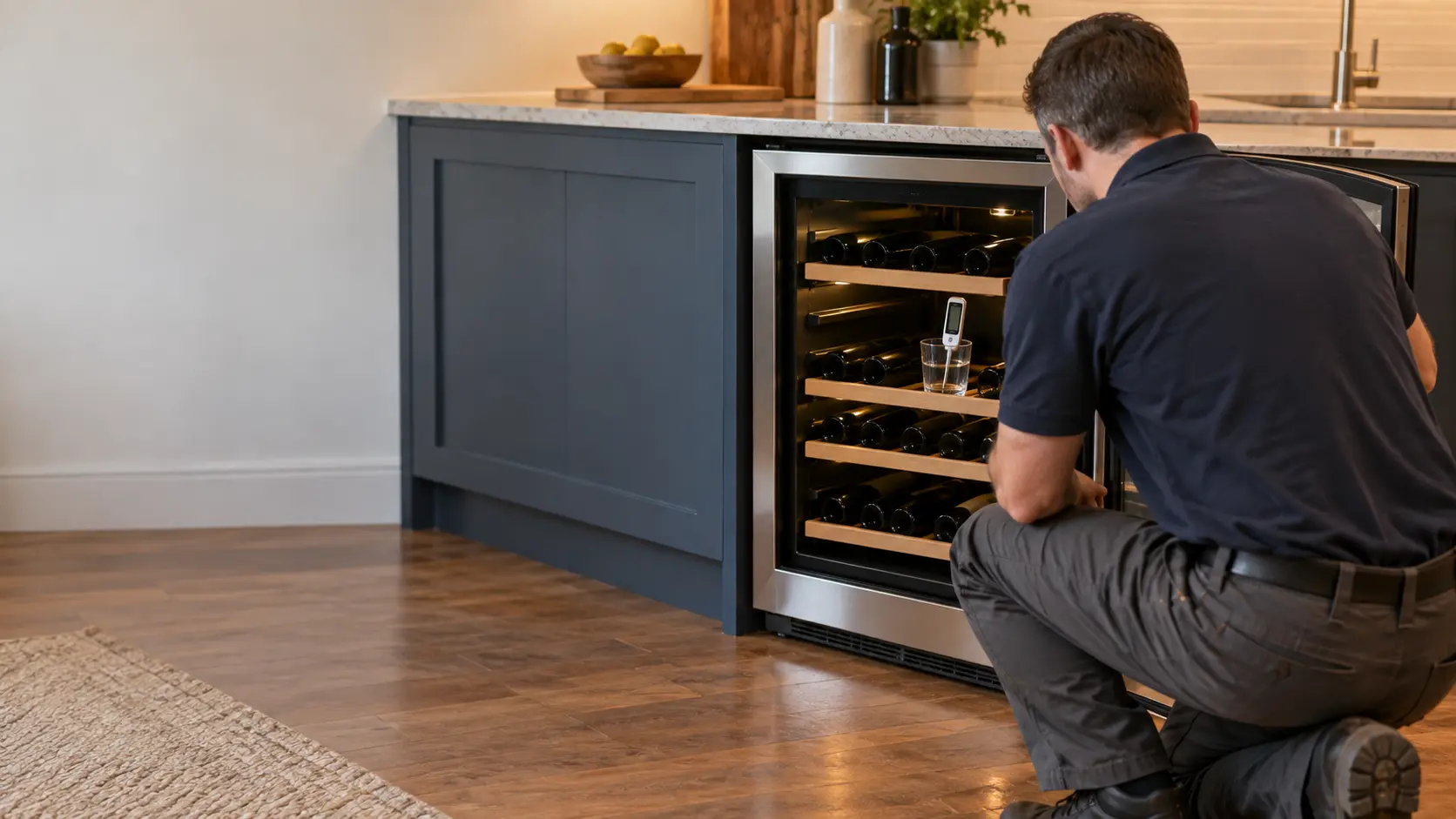
Resist refilling the moment the repair is done. Sub-Zero's warm-cabinet guidance says a new wine unit may need 24 hours to settle and that adding bottles raises the temperature for a time, with recovery depending on how many went in. Let the empty or nearly empty cabinet hold its setting for a full day, confirmed with a thermometer in a glass of water.
Then return the bottles over two or three days, a rack or a case at a time, starting with the ones you plan to keep longest. Checking each cork and capsule as it goes back in is worth the time: a cork pushed up or a sticky neck is a sign that bottle saw too much heat and should be opened soon.
Source: Sub-Zero — Warm Wine Storage Troubleshooting — A new wine unit may need 24 hours to cool; new wine placed in the unit raises the temperature temporarily, with recovery depending on how much was added