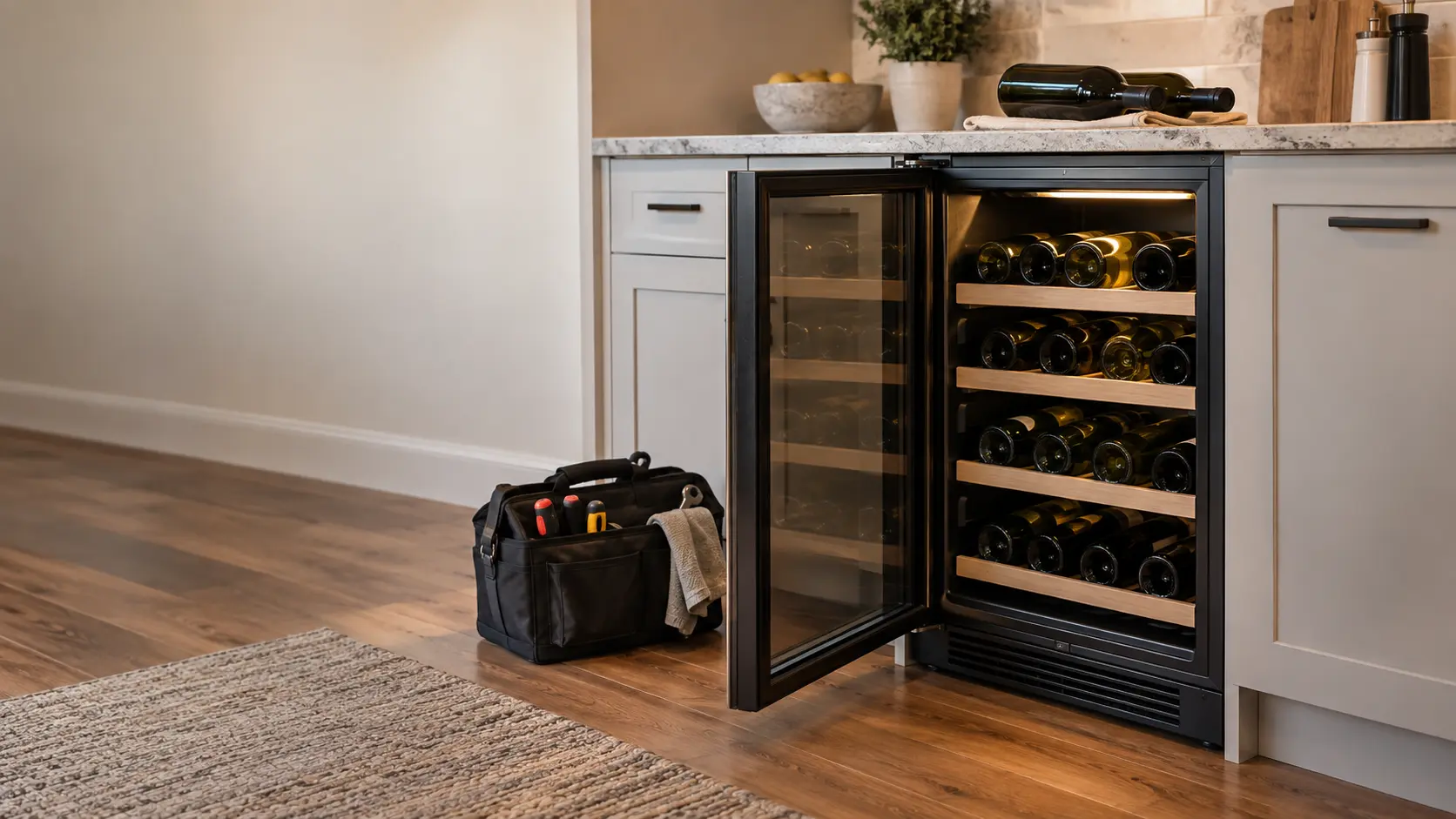
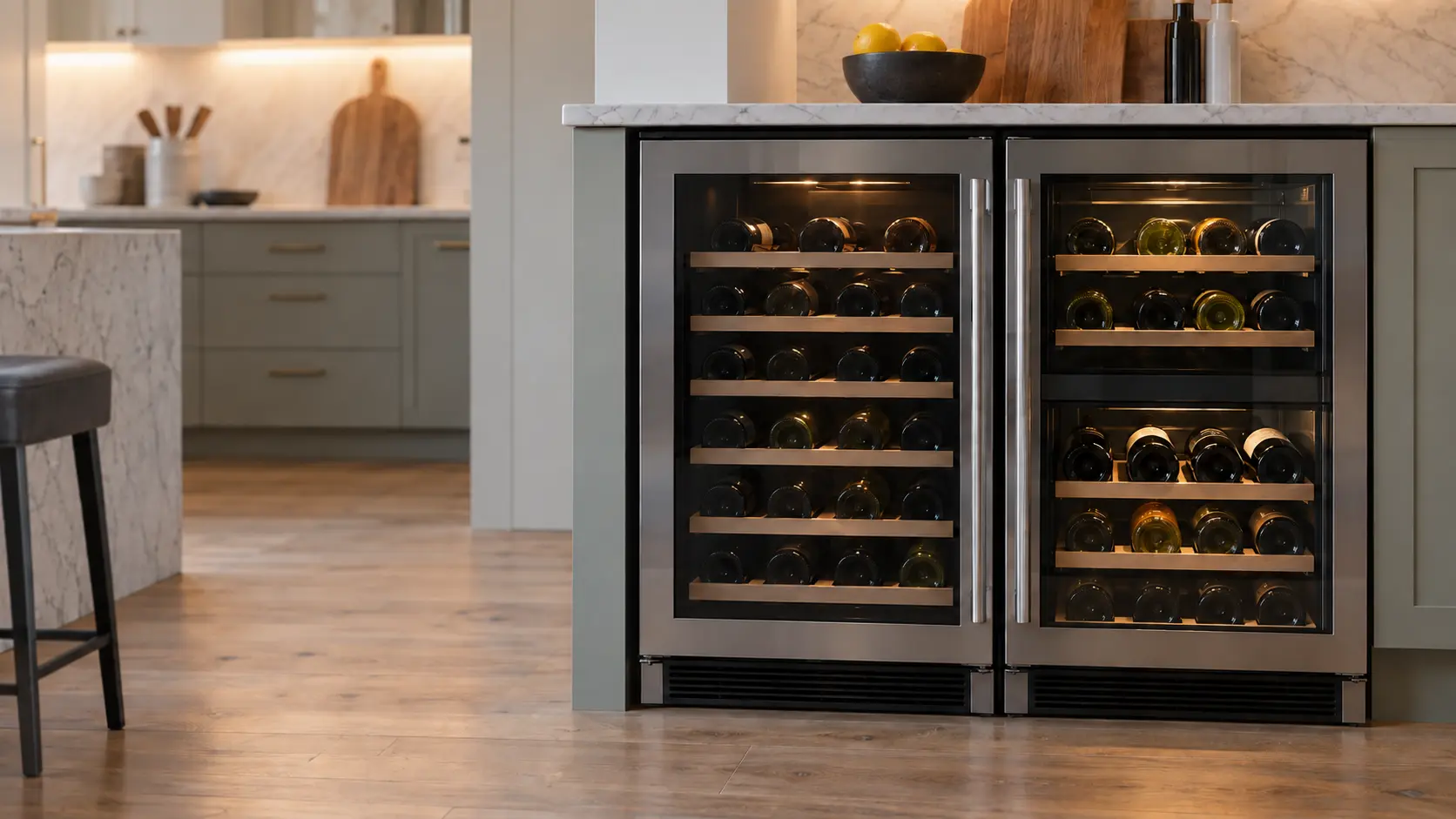
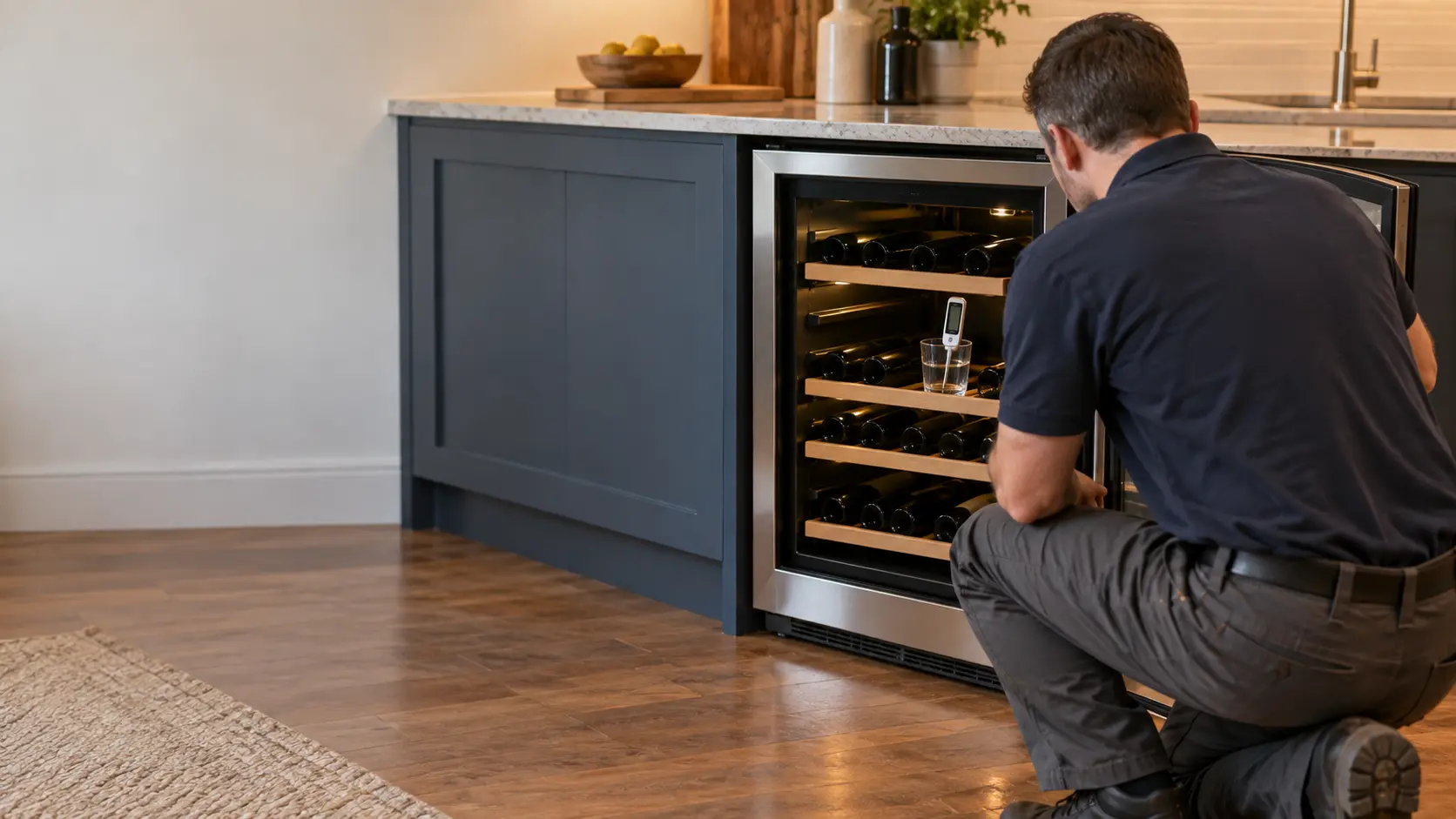
An undercounter wine cooler with its glass door open in a lived-in US kitchen, bottles lying on wooden racks inside, a few bottles set on a towel on the counter above it and a technician's tool bag on the floor.

Choosing and comparing

Repair or replace a wine cooler: the bottles first, then the part

Whether to repair or replace a wine cooler turns on the failed part, the kind of cabinet and what it holds. Fans, sensors, door gaskets, control boards and thermoelectric modules are modest repairs worth doing on most units. A sealed-system repair on a small freestanding model is often not, while a built-in column or undercounter unit sized to its opening usually is.

(844) 709-0727

Mon–Sat, 8am–8pm

  • One zone or two, keep it or replace it
  • 4-minute read
  • Across every type and make

Book a visit

Three short steps, about a minute.

or call (844) 709-0727

At a
glance.

The cabinet is only part of what is at stake. A wine cooler that fails also puts the bottles inside it at risk, and a built-in one is tied to the cabinetry around it, so the answer depends on more than the age printed on the model plate.

Read the whole guide

Usually worth repairingFans, sensors, gaskets, hinges, lights, control boards

The cheapest kind of repair, often done in one visit.

The hard callA compressor, a refrigerant leak or a restriction

Sealed-system work is the most expensive kind a wine cooler can need.

Built-in columns and undercounter unitsUsually repaired

A new one has to match the opening, the panels and often a partner column.

An old compressor unit's refrigerantHas to be recovered first

Under EPA rules, whoever finally scraps it must see to that.

Deal with the bottles before the decision

A warm wine cooler is not a spoiled-food emergency, but it is a slow one. In a tasting Liebherr describes, wine kept at 23°C, about 73°F, showed hardly any difference after six weeks, while after twelve months the same warmth had clearly aged it early. Heat that swings up and down with the room makes matters worse. Whatever you decide about the machine, the first job is to keep its contents cool and dark.

If the cabinet is still running and a few degrees warm, leave the door shut and the bottles where they are while you arrange a diagnosis. If it is dead or climbing toward room temperature, move the most valuable bottles to the coolest dark corner of the house, a basement closet or an interior room away from appliances, and lay them on their sides.

Source: Liebherr FreshMAG — Storing wine: the most important factors — Wine stored at 23°C showed hardly any difference after six weeks and clear premature aging after twelve months

What failed, ranked by what it usually involves

The same symptom, a cabinet stuck at 68°F, comes from very different parts. A fan that stopped behind the rear panel, a sensor sending a false reading, a door that no longer seals and a compressor that will not start all look alike from the outside. The decision to repair or replace a wine cooler cannot be made sensibly until someone has said which of these it is.

  • Smaller jobs: door gasket, hinge or door alignment, interior light, a fan motor, a temperature sensor, a display or its ribbon cable.
  • Middle: the main control board, a dual-zone damper, a thermoelectric module or its power supply, a drain or condensate heater.
  • Largest: a failed compressor, a refrigerant leak in the evaporator or tubing, or a blocked capillary, all sealed-system work.

The thermoelectric exception

A thermoelectric cabinet has no sealed system at all. Its worst case is a module and a power supply, which are modest parts, but on a small countertop unit even those can approach the cost of a new cabinet. Check whether the parts are still sold for the model before booking anything.

When you have been told the compressor is gone

Ask how it was confirmed. A compressor that clicks and will not start may be held back by a start relay or overload the size of a matchbox, and a cabinet that runs without cooling may have a stopped condenser fan rather than a failed pump.

Close on a new small cooling fan held beside the open back of a wine cooler, the cooler unplugged.

How the type of cabinet changes the answer

Size and installation shift the balance more than age does. A freestanding compressor unit holding a couple of dozen bottles is a simple swap: unplug one, plug in another. A sealed-system repair on it often costs more than it is worth, especially past its first several years.

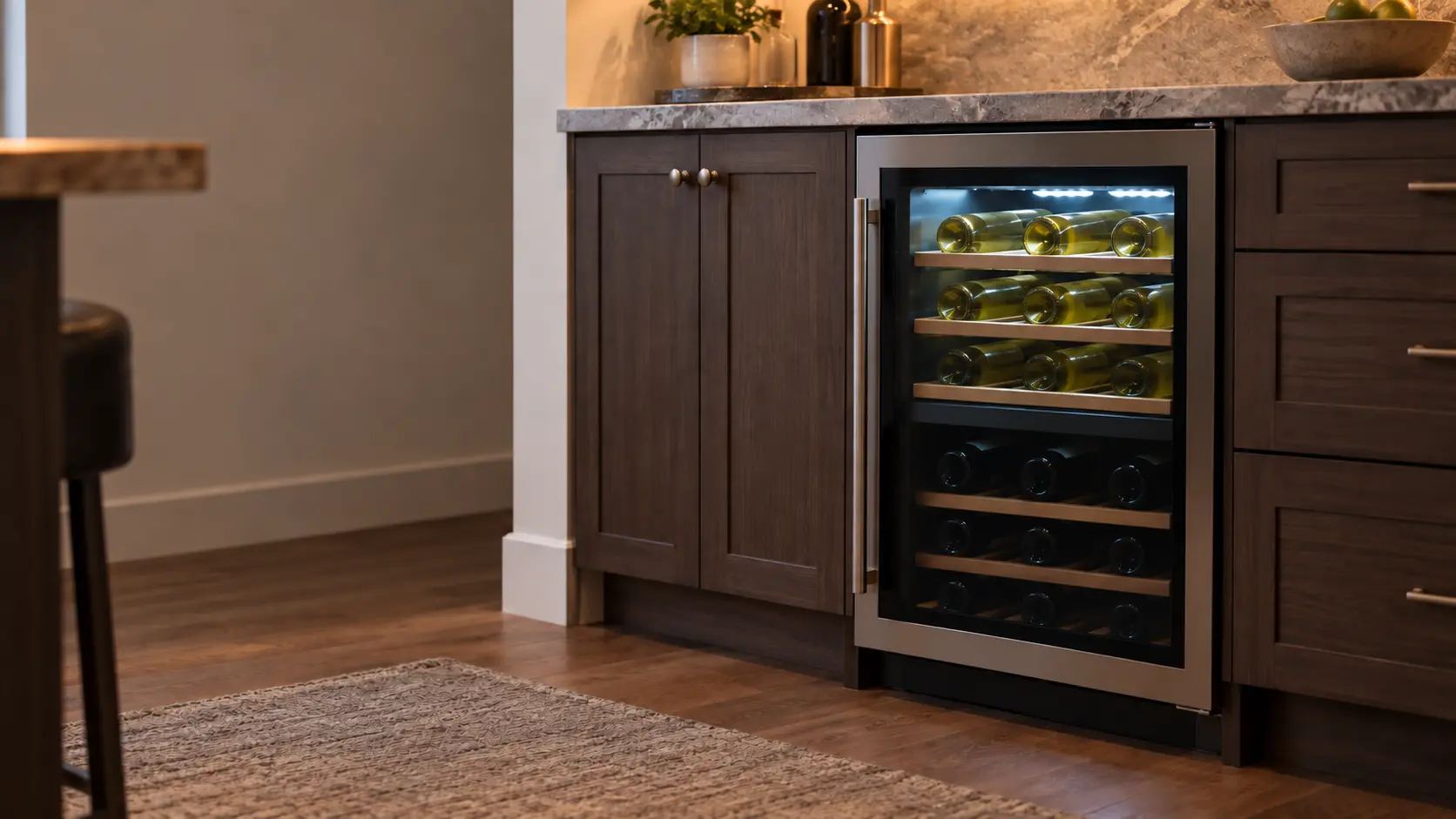
Built-in units are the reverse. An undercounter wine cooler fits an opening measured to the fraction of an inch, often with a custom panel or trim, and a wine column may stand beside a matching refrigerator or freezer column in a shared frame. Replacing either can mean a model that no longer fits, a panel that has to be remade and a kitchen that looks mismatched. On these, even a compressor replacement is routine work and usually the better value.

Dual-zone units with one zone failing

When one section still holds its setting and the other drifts, the cooling system is often healthy. A damper, a zone fan or a zone sensor is the usual cause, and that points strongly toward repair.

Costs that do not appear on a new cabinet's tag

Buying new brings its own list. The collection needs somewhere to wait while the old unit leaves and the new one settles, and the manual for a new compressor model says how long it should run empty before it is loaded. A built-in replacement may need a carpenter as well as a delivery crew.

The old cabinet cannot go out with the trash if it has a compressor. Under EPA's disposal rules, the scrap yard or landfill that finally receives a household appliance with its refrigerant still inside is the party that has to make sure the gas is captured. Use a retailer haul-away or a recycler that recovers refrigerant, and never cut the lines to make the unit lighter.

  • Temporary storage for the bottles, cool and dark, for a day or more.
  • Pickup of the old cabinet by someone who captures the refrigerant.
  • Panels, trim or cabinet work for a built-in opening.
  • Time for the new unit to stabilize before the collection goes back in.

Source: US EPA — Stationary refrigeration safe disposal requirements — Household appliances that reach the waste stream with refrigerant inside are subject to safe disposal rules; the final person in the disposal chain must ensure the refrigerant is recovered

Four questions that settle most cases

Is the failed part in the smaller half of the list above? Is the cabinet built in, sized to its space or paired with another column? Is the collection inside worth more than the appliance, so that a reliable, known machine matters? And are parts for this model still available? Two or more answers leaning toward repair usually mean repair; a small freestanding unit with a sealed-system failure usually means replacement.

A couple choosing a bottle together from an undercounter wine cooler in a warm kitchen at dusk
For the heart of your home.

Questions
owners ask.

Is a ten-year-old built-in wine cooler worth fixing?
Often, yes, because the replacement has to fit the same opening and panels. Unless the cabinet has needed several major repairs in a short time, a single compressor or board replacement is usually the better value.
Can a refrigerant leak just be topped up?
Adding refrigerant without finding and sealing the leak only buys a few weeks or months. A proper repair locates the leak, fixes it and recharges the system, which is why it sits at the top of the cost list.
How long can the bottles wait in a warm cabinet?
Days are rarely the problem; months of warmth are. Liebherr reports little change after six weeks at about 73°F and clear early aging after a year. Move anything valuable to the coolest dark place in the house if the cabinet is climbing toward room temperature.
Where does the old cabinet go once it is replaced?
Arrange a haul-away through the retailer or take it to a recycler that recovers refrigerant. Thermoelectric cabinets hold no refrigerant but still belong with electronics recycling rather than household trash.

Back to your everyday

Read it and still not sure?

Book with what you checked and the model number, and the technician starts where the guide stopped.

(844) 709-0727 Schedule a repair